It isn't that Joe Wright's film is necessarily the best to enter the Oscar frame so far, but it's the first - and perhaps the only - likely nominee guaranteed to make the Motion Picture Academy's members salivate continuously for the next three months. How can they resist a sumptuous English-country house mystery, starring Keira Knightley and James McAvoy as starcrossed lovers, that segues into a world war II epic?
Wright's film, adapted from Ian McEwen's novel by Christopher Hampton, falls into the same category as other highly-charged wartime romances that have won the best picture award: Gone With the Wind (1939), Casablanca (1943), From Here to Eternity (1953), Reds (1981), and The English Patient (1996), or, in the case of Doctor Zhivago (1965), ended up a near miss.
The English Patient's nine-Oscar haul augurs particularly well for Atonement's chances. Anthony Minghella's film, also adapted from a literary novel about a tragic affair with an aristocratic accent, fought off Fargo, Jerry Maguire, Secrets and Lies, and Shine.
Whatever universal emotions those films plumbed, they were all small scale, parochial, unglamorous, and unsexy compared with The English Patient. Only the Coen Brothers' Fargo was visually beautiful, but in the eyes of the academy's membership, snowbound Minnesota doesn't compare with the Sahara desert and an Italian villa. The voters at least had the taste to award Oscars to both Frances McDormand, Fargo's cheerful pregnant cop, and Juliette Binoche, The English Patient's sympathetic nurse.
Along with Atonement, the Coens' No Country for Old Men and Ridley Scott's American Gangster are certain best picture nominees. The indie comedy, Juno, blessed by Ellen Page's supremely sharp and affecting portrayal of a pregnant teen; Tim Burton's Dickensian film of the Sondheim musical, Sweeney Todd; and The Kite Runner are the leading contenders for the two remaining slots, though the latter is hampered by the controversy surrounding its depiction of the rapes of boys in ethnically divided Afghanistan. Waiting in the wings are The Diving Bell and the Butterfly, Charlie Wilson's War, There Will Be Blood, and Michael Clayton.
The Oscar-winning formula that none of these films fulfills, and which Atonement does, is a canvas as teeming as it is intimate, equal amounts of passion and gravitas, and the kind of tortured romance that was once a Hollywood staple. The love affair between Cecelia Tallis (Knightley) and Robbie Turner (McAvoy) - consummated and then sundered - is reminiscent of the tempestuous unions of Scarlett and Rhett, Rick and Ilsa, Zhivago and Lara, Reds' Louise Bryant and John Reed, and The English Patient's Katherine Clifton and Count Almásy.
On the evidence of Atonement and 1995's Pride & Prejudice, his first feature, Wright is a romantic pictorialist in the style of David Lean, even more so than Minghella. Lean made six films that were nominated for the best picture Oscar and was nominated as best director seven times, earning him the disparagement of François Truffaut.
The films that won in both categories were, admittedly, not love stories but epics about wayward military visionaries, Bridge on the River Kwai (1957) and Lawrence of Arabia (1962). But Lean's Zhivago, Ryan's Daughter (1970), which has begun to emerge from the shadow of its initial critical mauling, and A Passage to India (1985) are truly cinematic dramas that variously show how love and desire are inextricably bound to attitudes to class, nationality, and race in times of political upheaval.
In A Passage to India, the "attempted rape" of Adela Quested in the Marabar caves and its catastrophic consequences for Dr Aziz, deftly handled by Lean, clearly anticipates the plight of Atonement's Robbie, himself an aspiring doctor.
McEwen's novel is a metafiction presented, retrospectively, as a roman à clef written by Briony Tallis, who began it in her late teens and completed it as a septuagenarian to atone for destroying Cecilia and Robbie's relationship and, indirectly, their lives. We first meet the movie's Briony (Saoirse Ronan) when she is a 13-year-old writer mounting a cautionary play about an elopement for the weekend guests at the palatial country house where she lives with Cecelia, her soignée older sister, and their mother, a languid snob straight out of Jane Austen.
Robbie, the widowed housekeeper's son, has been put through Cambridge by the absent patriarch, but had avoided Cecelia there because of the social gulf between them. Now they are back, she is furious at him for not acting on their unspoken love. Briony, meanwhile, harbours a dangerous crush on Robbie.
Like Catherine Morland in Austen's Northanger Abbey, one of several key texts on which McEwen drew, Briony chooses to believe what she imagines. On the same fateful night, she spies on Cecelia and Robbie having consensual sex in the library and interprets it as rape, then wrongly concludes that Robbie was responsible for the rape of Lola, her Lolita-ish cousin.
Her foolish play forgotten, she becomes an author of tragedy, spreading her fantasy like a disease and causing her family, Cecelia excepted, to close ranks against Robbie. He goes to prison for three years, is briefly reunited with Cecelia, and fetches up among the stragglers trying to rejoin the British Expeditionary Force at Dunkirk. It's up to Briony - now played by Romola Garai - to reunite the lovers; Vanessa Redgrave plays the dying Briony in the coda.
Lean occasionally strayed into floridness in his big romances. In contrast, Wright's love scenes are electrifying. They are also laden with symbolism. Early in the film, Briony looks out of her bedroom window to see a mystifying confrontation between Robbie and Cecelia beside the fountain on the great lawn.
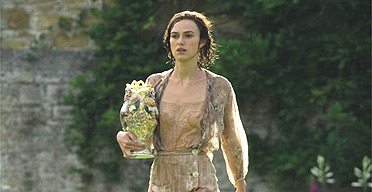
We subsequently see it up close, as Briony imagines it for the first draft of her novel, which she originally titled Two Figures By A Fountain. Robbie approaches Cecelia as she is about to fill a valuable vase. He reaches for her, causing the vase to break. One shard falls at her feet - she will lose her virginity that night - and another into the pool.
Seething, she strips to her slip and plunges into the pool to retrieve it, emerging like a naiad. The sequence has a mythic quality, in keeping with the Arcadian setting and classical mise-en-scène of the film's first half.
In the film's chaotic second half, Wright abandons this classicism as war whisks Robbie to France and the sisters to nursing jobs in London. As Robbie descends onto the beach at Dunkirk, a five-minute steadicam shot, weaving in and out of his perspective, traces his progress through a hell of destruction, disorder and drunkenness.
The beaten Tommies have become a mob and the officers can no longer control them; the death knell of the old social order has been sounded. Caught between one class and the other, his professional and romantic hopes wrecked, Robbie can only lurch into a cinema hall, where a last dream of Cecelia awaits him. Their "future" is now in Briony's hands.
Powerful though the shot is, it's the work off a young director who can't resist the urge to show off - his love of a constantly roving camera borders on the fetishistic. Sometimes Atonement's beauty is empty, though never when Knightley and McAvoy are on screen. "We'll always have Paris," Rick tells Ilsa in Casablanca. Robbie and Cecelia will always have the library - and, come February, Atonement could have a shelfload of Oscars.
