
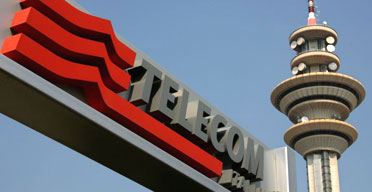
The crisis surrounding Telecom Italia intensified yesterday when police who were investigating alleged wiretapping at the country's fourth-largest company, arrested 20 people, including security managers, public officials and carabinieri in several towns.
The arrests come amid a ferocious political, economic and regulatory battle over the future of the Italian telecommunications group that has already seen the resignation of its chairman and main shareholder, Marco Tronchetti, and of a senior aide to premier Romano Prodi, head of the shaky centre-left coalition.
The crisis at Telecom Italia (TI) also highlights the ideological war going on inside Mr Prodi's government between an old guard of nationalist protectionists accused of wanting a return to the state interventionist industrial policies of the 1950s, and modernisers around Tommaso Padoa-Schioppa, the finance minister, who are keen to revitalise the Italian economy through liberal reforms.
The economy, Europe's fourth-largest, is beset with low growth and productivity and deteriorating competitiveness. Its public finances are in such a parlous state that commentators are openly pondering whether Italy might have to leave the eurozone and resolve its problems through devaluation. Mr Padoa-Schioppa, a former European Central Bank executive director, has been entrusted with avoiding that debacle by securing a 2007 budget that cuts the deficit below the 3% ceiling imposed by the Maastricht criteria and controls the state debt, which is almost twice as high as the 60% eurozone limit.
However, in light of the Telecom Italia crisis, Mr Prodi is now under intense pressure from within his nine-party coalition to abandon one of the key elements of that financial cure - privatisation of state assets, including holdings in firms such as energy group Enel.
U-turn
The TI debacle exploded last week when Mr Tronchetti announced a strategic U-turn, abandoning the "converged" approach to mobile and fixed-line telephony. Instead TI was to be split into a core media business, including the broadband operations, a holding company for the firm's Italian fixed line network, and a mobile business.
The move lays TI's mobile and fixed line businesses open to a takeover by foreign buyers, which has infuriated many left-wing Italian politicians. TI's mobile business, TIM, worth about €30bn (£20bn), was bought only two years ago. There is also speculation that TI could sell its €9bn Brazilian business.
The move surprised Mr Prodi, and amid speculation that he had been privy to the plan, he took the incredible step of releasing details of two meetings he had with Mr Tronchetti earlier this year. While the meetings included comments from Mr Tronchetti about talking to Rupert Murdoch about the media mogul taking a stake in the business - in return for selling Sky Italia - they did not include full details of the three-way split.
Crucially, Mr Prodi asked whether a stake sale would mean that control of TI would move out of Italian hands; Mr Tronchetti had said it would not.
These talks, now dismissed as "never serious", also embraced other partners, such as Time Warner and GE.
Mr Tronchetti has now been replaced by Guido Rossi, a proven corporate governance expert who, ironically, helped privatise TI in the 1990s.
Mr Prodi, whose first government collapsed in 1998, has denied that he and his ministers ousted Mr Tronchetti over his U-turn, but is known to have felt that the former TI chairman had lied to him.
It is also known that Angelo Rovati, Mr Prodi's adviser who quit on Monday, had argued for the re-nationalisation of TI's infrastructure network, an option favoured by some hard-left ministers worried that Silvio Berlusconi, the discredited former prime minister, would move in on TI assets.
Andrea Renda, an Italy-based researcher at the centre for European Policy Studies and an expert in telecoms regulation, said TI's change of strategy followed a decision by the Italian regulator to follow the model set out by British telecoms regulator Ofcom. Under Ofcom's plan, BT's local network of exchanges and phone lines sits within a "ring-fenced" business, called BT Openreach, a unit that deals with BT's retail arm and any telecoms rivals needing BT lines for domestic sales. TI saw a move in this direction as damaging to its "convergence" strategy of integrating the fixed and mobile networks.
'Banana republic'
Antonio Missiroli, chief policy analyst at the European Policy Centre, said the TI row mirrored other industrial policy disputes, such as the government's decision to block the takeover of Autostrade, the motorway operator, by the Spanish firm Abertis - despite warnings from the European commission that it infringed EU rules.
Some commentators say the TI episode has exposed Italy as more akin to a banana republic but Mr Missiroli is less caustic. "In the end, the group around Padoa-Schioppa which favours more liberalisation may succeed provided it can deliver on the 2007 budget. It's very difficult to get it through with this two-seat majority in the Senate and it's not clear whether the opposition will cooperate. But if he wins here he will win on the other issue, and this will set the pace."
Backstory
Since Telecom Italia's decision two years ago to buy back control of its mobile phone business, TIM, and run it and the fixed line division as one unit, the company has been heralded as the epitome of a "converged" media and telecoms business. Its Italian operations stretch from fixed and mobile telephony to residential broadband and TV over the internet. The company even owns an Italian TV station, La7, which despite a small audience share is seen as equivalent of Channel 4 when it comes to innovative and risk-taking programming.
As a result, last week's decision to split the business raised a question mark over the convergence strategy so highly regarded by other European telecoms and media players. Traditional telecoms companies such as BT are moving into TV while mobile phone companies from Vodafone and O2 to Virgin Mobile are looking to get into residential services such as broadband. Even Sky has started offering internet access to its customers. Analysts believe, however, the U-turn at TI owes more to moves by the regulator to open up the Italian market and the need to reduce the company's debts, than any structural issues about convergence.
