Having suffered seven years of career freeze, the director Terry Gilliam might have felt entitled to a warmer reception when he finally returned to the day job. It was not to be.
His comeback film has been mauled by the press ahead of its American release today.
The Brothers Grimm is Gilliam's first completed picture since his 1998 adaptation of Fear and Loathing in Las Vegas.
In the meantime his most notable appearance was as the hapless star of the 2002 documentary Lost in La Mancha, which charted - in excruciating detail - the collapse of the film-maker's long-cherished The Man Who Killed Don Quixote, starring Johnny Depp. In the aftermath of that calamity, Gilliam struggled to raise funding for a string of projects and admitted that his confidence was at rock bottom.
The Brothers Grimm was intended as a riposte to those who suggested that the man behind Time Bandits and Brazil is too unruly and iconoclastic to be entrusted with a large-scale Hollywood production.
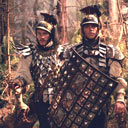
Budgeted at about $80m, the flamboyant Gothic concoction stars A-list actors Matt Damon and Heath Ledger as a pair of charlatan siblings who uncover a fairytale curse in the forests of 19th century Germany.
At this year's Cannes film festival, the director admitted that he hoped the film's success would pave the way for another stab at Don Quixote.
"Johnny [Depp] and I made a deal when Quixote collapsed," he told the Guardian. "He said, 'You make a commercial film, I'll make a commercial film and we'll get the money to do Quixote.' He made Pirates [of the Caribbean]. Grimms is my commercial film."
But those plans are now in doubt, with US critics lining up to deride the film. According to Robert Koehler in the film industry newspaper Variety: "The Brothers Grimm is deeply lost in the woods. From its depiction of the German author-kin as conmen to its frenetic and exhausted conclusion there's little appeal, save for those looking for a late August distraction."
In the New York Observer, Rex Reed was still more scathing. "Gilliam has no clear idea what he's doing," he wrote, "so the movie is nothing more than noise, costumes and disjointed special effects."
Various reviewers have blamed the film's failure on the tense collaboration between the director and his producers. The Brothers Grimm is supported by former Miramax frontmen Bob and Harvey Weinstein, who threw Gilliam a lifeline after the original backer, MGM, pulled out of the project.
But the relationship was hardly plain sailing. The former Python has admitted being "at loggerheads" with the Weinsteins and at one stage took a six-month break from the production following an argument over the film's final direction.
The finished product has been seen as an uneasy compromise. Premiere magazine described The Brothers Grimm as "a cage match between Gilliam's sensibilities and the more traditional Hollywood concerns"
The New York Press found it "too slight and superficial - too blockbustery - to carry the weight of the director and screenwriter's ambitions".
Perhaps Gilliam has always been too exotic a film-maker to adapt to the ironclad demands of the Hollywood system.
One of the few unabashed champions of the film was the more highbrow, Manhattan-based Village Voice, which hailed it as "a daffy, genre-hash gambol, descendant of the Hammer Film school and just as fabulously cartoon-Gothic as Sleepy Hollow".
It wistfully concluded: "If only summer movies were, as a matter of course, this inventive, this modest, this interested - even derisively - in cultural legacies, this faithful to concept and setting."
In Cannes, Gilliam expressed the hope that The Brothers Grimm would make $200m at the box office. That forecast might have to be revised now, but one has the sense that Gilliam's troubles are drawing to a close.
During his enforced six-month hiatus from the film, he passed the time by shooting a small-scale, low-budget adaptation of the Mitch Cullins novel Tideland. It is scheduled for release early in 2006.
Bloodied but unbowed, Terry Gilliam is back in the game at last.
The rocky road from the Holy Grail
The high: Monty Python and the Holy Grail (1975)
Having cut his teeth as the madcap animator on Monty Python's Flying Circus, Gilliam made his feature debut (directing alongside Terry Jones) with this anarchic portrait of an Arthurian Britain bedevilled by killer rabbits and coconut shells.
The low: Jabberwocky (1977)
Gilliam's second voyage to Olde England was rather less fruitful. Admittedly, Jabberwocky has its defenders. But this be-grimed comedy remains too crammed, incoherent and ill-conceived
The high: Time Bandits (1981)
Produced by George Harrison's Handmade Films, Time Bandits was Gilliam's first truly great movie: a delirious fantasy full of squabbling dwarves, hidden treasure and fairytale castles.
The low: The Adventures of Baron Munchausen (1988)
Flushed from the success of 1985's Brazil, Gilliam duly came a cropper with this costly folly. Munchausen looked a treat. The script, however, was a mess.
The high: 12 Monkeys (1995)
Taking Chris Marker's La Jetée as his starting point, Gilliam drafted in Hollywood stars (Brad Pitt, Bruce Willis) and spun an apocalyptic fantasy that remains one of the smartest blockbusters of recent years.
The low: Lost in La Mancha (2002)
In which the director tries (and fails) to keep Don Quixote on the rails as disaster rains down. Gilliam had mixed feelings about the documentary, which he felt did him few favours in his quest to secure cash for future productions.
