
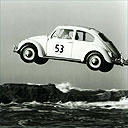
Volkswagen cars are to become stars of the cinema and television screen again after the German group signed a ground-breaking product placement deal with American entertainment group NBC Universal.
The Volkswagen Beetle was an unlikely matinee idol in the 60s and 70s, thanks to the adventures of Herbie, whose film career was launched by the Love Bug and stretched to three more outings.
The owner of the NBC TV network and the Universal film studio will feature Volkswagen products in films, DVDs, TV programmes and its theme parks worldwide. In exchange, the German car manufacturer will feature NBC Universal movies and TV shows such as ER and Van Helsing in its promotions.
The tie-up between a major advertiser and an entertainment group formalises a relationship between the corporate and media worlds that has been growing at a rapid pace over the past decade. The growth of personal video recorders, which allow viewers to skip TV advertisements, and other forms of advertising such as the internet, have encouraged broadcasters to seek new ways of placing advertisements in front of TV watchers.
Product placement is also a common component of Hollywood film financing. In recent years the James Bond franchise has become a marketing outlet for British Airways and Omega watches, while some film critics last year objected to repeated references to Converse Allstars trainers in the Will Smith vehicle, I, Robot.
"We are very proud to be in business with a creative and dynamic company such as Volkswagen," said Ron Meyer, president of Universal Studios. "Our historic alliance underscores how important corporate partnerships have become in attracting customers."
Volkswagen will be offered product placement, a presence at Universal film premieres and on DVDs and joint promotional campaigns. The contract also gives Volkswagen a say in creating new TV programmes and allows the company to take part in "on-air film-related promotions".
Product placement on TV, the inclusion of a product in a programme in exchange for a payment to the broadcaster, is banned in Britain. Flextech, co-owner of the UKTV channels, is among the broadcasters in favour of a more relaxed regime. Charles Allen, the chief executive of ITV, said last year that product placement has "a part to play" in commercial broadcasting.
Andy Roberts, the executive buying director at media buyer Starcom Motive, said product placement in Britain would have to be more low-key than its American equivalent. "Certainly there's a greater need for advertisers to look at how they can get inside content or get closer to it.
"It's a route that they have to take. You can see how it is less of an issue in the US, where the regulatory environment is more liberal, but it is frowned upon in the UK.
"I support advertisers' motives for wanting to get involved in editorial in a genuine way, but it is critical that it is genuine. There is no point in having overt product placement a consumer can see through."
