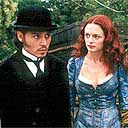
It is already being described as the goriest movie about Jack the Ripper ever made. From Hell, directed by Allen and Albert Hughes, has electrified American audiences and is due to open here in February. It stars Johnny Depp as Inspector Abberline, the opium-addicted detective who falls in love with one of the Ripper's victims, played by Heather Graham (this is Hollywood, after all). The props include extraordinarily realistic plaster casts of the victims' mutilated bodies (which have now apparently been bought up as souvenirs by the weird US rock star Marilyn Manson). So sure was the studio of the Ripper's continuing box-office appeal that it went to the trouble of turning a section of Prague into a replica of Victorian London.
The release of From Hell follows hard on the heels of an announcement by Patricia Cornwell, the eccentric American thriller writer, that she has identified the painter Walter Sickert as the killer. So convinced is she of Sickert's guilt that she has been buying his paintings and has actually cut up one of his canvases in the vain hope of finding proof.
Meanwhile, Jack the Ripper walks have become a standard part of the London experience for many tourists. These ghoulish processions are increasingly unpopular with local people - stones have been thrown at tour groups, and a 53-year-old woman from Essex was wounded by pellets from an air gun in Spitalfields in October - but the killings have nevertheless become part of our heritage industry.
The online bookstore, Amazon, now lists 57 books about the Ripper murders, and that does not include the hundreds of volumes that are no longer in print. Most of the authors are men and they have a tendency to disguise their grisly subject-matter, using titles that sound like children's encyclopedias: The Ultimate Jack the Ripper Sourcebook, The Complete Jack the Ripper, The Mammoth Book of Jack the Ripper. You would barely know that the Whitechapel murders involve some of the most brutal mutilations of women's bodies in the history of crime.
Ripper enthusiasts say this is beside the point. They claim their interest stems from the fact that the Whitechapel killer is an early manifestation of a type of criminal who emerged from urbanisation and the breakdown of agrarian society. Others say that the murderer's enduring appeal is much simpler, resting on the fact that he was never caught.
But no one has ever explained the purpose served by identifying him, even supposing such a thing to be possible. Anyone who claims to have done so will be shot down in flames by other Ripper enthusiasts, but it does not stop them trying. Each new claim and rebuttal generates acres of publicity, which is surely the point. It provides a justification for rehearsing the gruesome details yet again, more than a century after the actual crimes. Some editors even go as far as publishing a photograph of one of the mutilated victims, an indignity that would not be permitted with more recent murders.
The truth is that this kind of violence is titillating, and some readers and viewers cannot get enough of it. Where psychologists who work with serial killers see them as damaged individuals, with a compulsive need to repeat their destructive behaviour, amateur criminologists endow them with almost supernatural powers. (The title of the Hughes brothers' film, From Hell, explicitly locates the killer in that infernal region.)
The ambivalent, quasi-heroic status of serial killers was demonstrated in the late 1970s, when football crowds taunted the police with chants of "there's only one Yorkshire Ripper". Yet a real serial killer once observed that Hannibal Lecter, the anti-hero of Thomas Harris's novels, was entirely unconvincing: anyone as charismatic as Lecter, he pointed out, would not need to commit murder.
The fact that some Ripper "experts" insist that the Whitechapel killer belonged to the higher echelons of society - Victoria's grandson, the Duke of Clarence, and her physician, Sir William Gull, are favourite candidates - reveals the status he has attained in their minds. What these people are really saying is that the Whitechapel killer was special; they do not want to countenance the idea that he might have been an ordinary man who hated women, and who escaped the law because forensic science was in its infancy in 1888.
In that sense, the continuing mystery about the Ripper's identity obscures the fact that this is an unhealthy obsession. Why does this gruesome episode still fascinate? The novelist Robert Bloch, author of the book on which Hitchcock based Psycho, provided a clue when he urged his readers to "let the Ripper rip you into an awareness of the urges and forces most of us will neither admit nor submit to".
Bloch's exhortation suggests that the Ripper's crimes are transgressive, turning a brutal murderer into a glamorous outlaw figure. Even more disturbing is the implicit invitation to identify with him, as though the Ripper were simply honest enough to act on violent impulses that others habitually deny. One US journalist, Charles McCabe of the San Francisco Chronicle, went even further, saluting the Ripper as "that great hero of my youth, that skilled butcher who did all his work on alcoholic whores".
The fact that the Whitechapel killer was understood in this way even in his own time is demonstrated by the Lulu plays of the fin-de-siecle German dramatist, Frank Wedekind. The plays - adapted into Pandora's Box, the 1928 movie by GW Pabst, and an opera by Alban Berg - are a morality tale in which the heroine, an adventuress whose voracious sexuality destroys a series of lovers, eventually succumbs to Jack's fatal embrace. Wedekind's plays are about sexual anxiety, which was widespread at a time when gender roles were changing rapidly - the 1890s were the heyday of the "new woman" - and which continues to resonate in our own time.
This alternative explanation for the enduring popularity of the Whitechapel killer - that he feeds a mostly unacknowledged misogyny - is not comfortable to contemplate. The makers of From Hell, whose release in the US has ensured that "scream-filled multiplexes were prettily draped with the innards and viscera of Jack the Ripper's victims", in the words of one critic, would almost certainly argue that they are simply meeting an appetite for horror films. But the fact that so many movies, documentaries and books continue to be produced a century after the Whitechapel killer terrorised women in the East End, proves that this brutal murderer remains one of our most potent cultural icons.
