
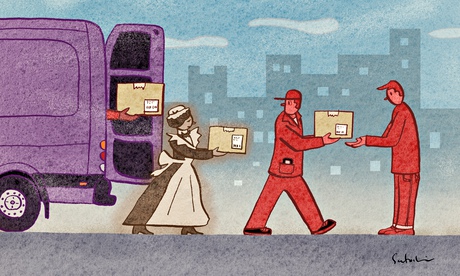
Once upon a time, Princess Olga Romanoff explained wistfully, if her mother needed a boy for menial work she needed only to telephone the “local comp” and ask. While she was at it, she could stock up on maidservants too. So handy.
But sadly for the landed gentry, or in this case deposed Russian royalty, the days of 14-year-old school-leavers mowing lawns and dusting chandeliers are long gone. As must be much of the Romanoff fortune, or Olga presumably wouldn’t have agreed to be filmed attempting to hire servants for her country pile as part of Channel 4’s new series You Can’t Get the Staff, whose title alone sounds designed to troll the sofa-bound into revolution.
Nobody, but nobody, sounds good talking about servants. The word reeks of Victorian parlour maids scrubbing their hands raw seven days a week while fighting off the rapacious under-butler; or, more recently, of flunkies cleaning celebrity yachts with a toothbrush. What grates is the idea of mastery over others, the preposterousness of thinking that having money entitles anyone to sit around like Lady Muck while someone else does the work one considers oneself to be above.
Asked why she needs a chef and a butler and another flunky just to have a few friends for dinner, the socialite Lady Colin Campbell told Channel 4 that it enables her to be “a hostess”, as if it were impossible to talk and clear plates. No wonder the Duke and Duchess of Cambridge, rather more sensitive to public opinion, initially suggested they might not have a nanny for Prince George but raise him themselves – inspiring endless gushing about Kate’s solidly middle-class values. Except that’s the last thing they were, because the middle classes are in the domestic service game up to their necks.
Homebase announced this week that it’s shutting one in four stores because, its chief executive said, people don’t do DIY now: they “look for third parties to help”. They get someone in to fix stuff, just as they might to iron or clean.
Odd, then, that you don’t hear many busy professional men apologising for having got a decorator to paint the house, instead of staying up half the night doing it themselves. Or male chief executives gushing that the handyman is more of a friend than an employee, really, and they always rush round tidying the toolbox before he comes. It’s just women who seem to tie themselves publicly in knots over whether it’s unsisterly to have a cleaner – for shame, building your success on the backs of lower-paid women! – or unsisterly not to, when doing everything yourself deprives someone else of a job.
For the record, in the past I’ve been both an au pair and an office cleaner (temp job, years ago, but never quite forgotten people’s inability to look you in the eye as you empty their bins). I’ve also employed a cleaner and a nanny, although no longer. It’s obvious which side of the fence is less fun, and which is more conducive to liberal cringing: not to mention the unshakeable feeling that you damn well should be doing this yourself, that others will judge you (and they will) for delegating the dirty work. Get her, too lazy to mop her own floor!
And while it’s obviously ridiculous to assume that cleaning and childcare is women’s responsibility, many of us find it hard to shake the burden. What makes all of this so loaded is that the more menial and intimate the service provided, from cleaning to caring to waxing bikini lines, the more likely a woman will be providing it. Hard to ignore that power dynamic when someone’s scrubbing your loo.
It’s true that the surge of women into the workplace has turned what was once unpaid work for full-time housewives into paid work – jobs magicked out of nowhere that have been quietly driving economic growth ever since. It’s been estimated that for every 100 women going out to work, 15 new jobs are created in industries from childminding to restaurants catering for people too knackered to cook. But it’s not just women who created our booming service economies, reliant on the time-poor and not always cash-rich westerners contracting out the things previous generations did for themselves. It’s men and women, in dual-income households where nobody ever has enough time, who built this deconstructed Downton.
Because if the definition of a servant is someone paid to perform duties on your behalf then what does that make Amazon? One click and someone else does the dirty work, scurrying round a giant warehouse to pick your shopping before someone else drives it to your door, like a grocer’s boy from a hundred years ago. Just because these days we hire in help from the outside, as and when needed, rather than housing it in the attic doesn’t change the basic nature of the transaction. Do anything from putting the kids in nursery to grabbing a takeaway coffee (what, you don’t have time to fill a thermos now?), and you’re relying on a form of domestic service.
In the 19th century, the maid would cut her master’s toenails at home. Now a manicurist in a nail bar is paid to do much the same thing.
What makes it all slightly more comfortable for everyone concerned is that people working in modern domestic service industries quite rightly don’t see themselves as servants: they’re trained professionals answering to armies of customers rather than one tyrannical employer, free to refuse work they don’t want. (Princess Olga’s first choice turned her under-gardener job down flat after discovering she was pro-foxhunting. One doubts that ever happened to her mother.) Those who hire them, meanwhile, aren’t using their free time to become society ladies rattling their pearls, but mostly to work and pay tax and contribute to society.
But even if the forelock-tugging is long gone, somehow the words “service economy” don’t exactly fill one with pride. That’s not just because gambling everything on an inexhaustible demand for haircuts and lattes seems risky, but because building an economy around richer people hiring poorer ones to run round after them feels – well, somewhere between undignified and offensive.
That’s the thing about Channel 4’s relics of a bygone age: raging at them may make you feel so much more enlightened, more industrious, more virtuous by comparison. But it’s perhaps also a form of grappling with what we have become.
