
Hopper accompanied the civil rights protesters on one of their famous marches from Selma, Alabama, to Montgomery, the state capital. The march was led by Martin Luther King in 1965, and Hopper was shooting continuously along the way. Here, he captures a group of children, one wearing a hat that reads 'Full Employment', while an older one carries the Stars and Stripes. ‘I wanted to document something,’ Hopper later said, ‘whether it was Martin Luther King or the hippies’
Photograph: The Hopper Art Trust Photograph: Dennis Hopper/The Hopper Art Trust
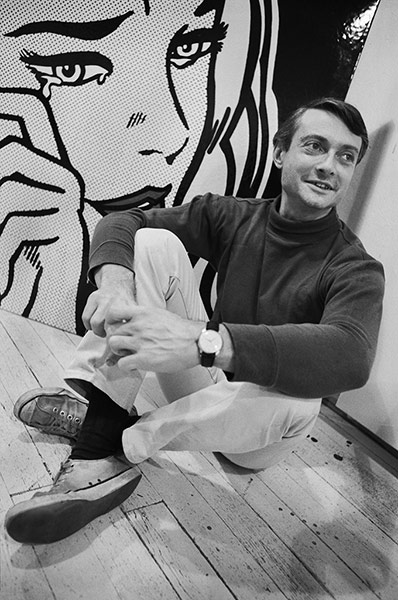
Hopper once said, ‘The only people that I really found comfortable being photographed were artists. They asked me to photograph them. They wanted to be photographed. And that was cool.’ This portrait of Roy Lichtenstein, whose early work Hopper bought, is a case in point Photograph: Dennis Hopper/The Hopper Art Trust


Hopper’s Hollywood rebel credentials allowed him access to several ‘scenes’ on both the east and west coast and in London. This group shot of Warhol, art dealer Henry Geldzahler, Hockney and Geldzahler’s friend Jeff Goodman was taken when Hopper was spending a lot of time at Warhol’s Factory; he was one of the first people to buy a soup can painting Photograph: Dennis Hopper/The Hopper Art Trust
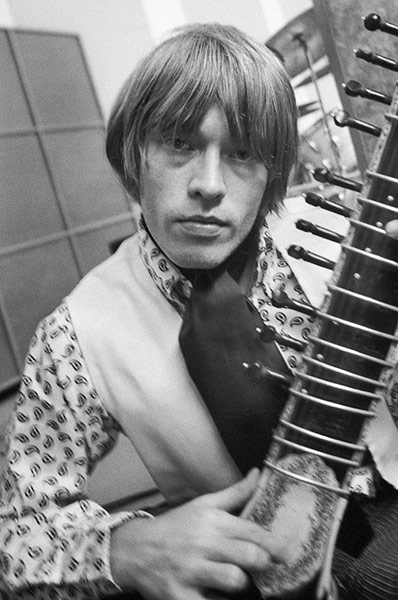
US Vogue commissioned Hopper to produce a portfolio of pop stars, including the Grateful Dead, the Byrds and James Brown. He befriended the Rolling Stones’ Brian Jones in England in 1965, and this portrait captures the guitarist cradling a sitar in a recording studio Photograph: Dennis Hopper/The Hopper Art Trust

Hopper’s street scenes are reminiscent of the work of Lee Friedlander and here he captures the city he lived in and loved. ‘LA was pop,’ he said, ‘LA was the billboards. LA was the automobile culture. LA was the movie stars and LA was the whole idea of what pop was about – commercial art’ Photograph: Dennis Hopper/The Hopper Art Trust

‘Dennis and I met sometime in 1961-62 at the Ferus gallery where we both were seeing an exhibit of Kurt Schwitters collages,’ says Ruscha. ‘With Dennis, there was not a lot of posing... He used his trusty Nikon 35mm camera. In 10 to 15 minutes, he had what he wanted’ Photograph: Dennis Hopper/The Hopper Art Trust


A hippy himself, Hopper became the symbol of a generation after the success of Easy Rider. This snatched portrait of a dancing ‘flower child’ in a San Francisco park is one of a series he made during the so-called summer of love Photograph: Dennis Hopper/The Hopper Art Trust


