
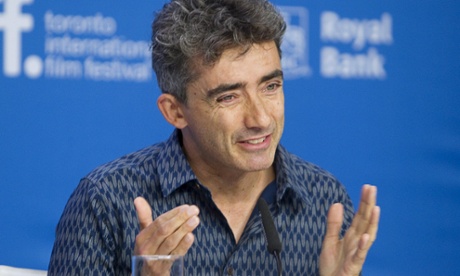
Fittingly, for a strand of the Toronto international film festival focusing on London cinema, the press conference for City to City: London was dominated by talk of house prices and Britain’s obsession with class.
Director David Farr, one of six British-based film-makers on the panel, said that the UK still had a “kind of madness” around the subject. A number of the directors agreed that the perception of British film-making as either period drama or gritty social realism was limiting the industry.
“The films that really drive me mad are the posh films about posh people made by posh people,” said Farr, whose feature debut, The Ones Below - about a middle-class couples’ psychological battle with their downstairs neighbours - premieres in Toronto today.
“Most of them are set in about 1930 and there’s always a king. They’re the ones that create the problem and we all shuffle around underneath this dreadful, awful thing. And that’s the bit [of the industry] you need to blow up”.
Tom Geens, a Belgium-born film-maker who moved to London 20 years ago, said there were not enough films about the middle-classes being made. He championed film-makers like Andrew Haigh and Joanna Hogg for exploring that area of British life.
“I want to see more stories about the gentrified people and go into uncompromising stories about them,” he said. “Uncomfortable stories about the middle classes, which you rarely see in the UK.
“They’re kind of the ignored class in a way, because it’s a lot of middle class people making films about [the] working class or gangs or drug dealers or council estates”.
Michael Caton-Jones directed Urban Hymn, a low-budget drama about a disturbed teenager (newcomer Letitia Wright) learning to channel her energy into singing with the help of her social worker (Shirley Henderson). He said that the middle-classes had had quite enough say in the film industry already.
“Filming is essentially a bourgeois sport,” he said. “The most loathsome kind of film is this heritage Britain: basically shilling for tourists to get people to come and visit the place. And it’s a kind of cultural dead end.
“Unfortunately the middle class have this cultural chokehold on what we get to make. If I sound bitter, it’s because I am,” he said. “It’s almost been ghettoised. Like the country. You can make an expensive picture with a Redmayne or a Cumberbatch, or you can go down the estates and hug some hoodies. That’s basically your choice”.
Another issue blocking artists is financiers reluctance to take a risk on anything that might prove confusing to an American audience, said director Elaine Constantine. Constantine, from Lancashire, brings her film Northern Soul, about the popular UK music scene, to Toronto.
“We’re playing poor relative to the US market,” she said. “Everything that’s produced has to be appealing to the American audience because of our language. I’ve been in so many meetings where people have said ‘You can’t do a film about the north and have people going ‘Eeeee … bloody hell’ because the Americans won’t understand’.”
Finally, the panel addressed London’s property crisis. Farr described the gap between rich and poor as “amazingly wide”.
“We’re at a real crux moment for the city,” he said. “Over the last 20 years there’s been this unbelievable creative explosion. But I feel right now the city is at a sort of breaking point: there were the huge social issues that lead to the riots, the massive issue around land.
“Like all cities where art explodes what happens is that money follows very, very fast. In some areas of London now, what used to be real proper artist areas … you can’t live there. It’s simply not possible”.
Caton-Jones said the best thing about London was that it’s a mosaic, with many areas where rich and poor live side-by-side. He said the film industry needs to make a greater effort to show that reality on screen.
“I don’t see films that reflect that too often,” he said.
The City to City strand is a part of the festival programme designed to highlight work from a city “undergoing a disturbance or transformation”, said festival director and CEO Piers Handling, who chaired the talk. In previous years the strand has put the spotlight on films from cities as varied as Seoul, Tel Aviv and Buenos Aires.
