The history of Australian cinema is littered with films about disenfranchised youth growing up in remote locations. The genre is so familiar to local artists that small town or rural coming of age stories – teen tragedies involving extreme lapses of judgment en route to hard-won maturity – have become something of a cliche.
Set in country New South Wales in 1962 and told from the point of view of a lovestruck 15-year-old boy whose romantic affections are not reciprocated, writer/director John Duigan’s 1987 drama The Year My Voice Broke somehow avoids stereotype despite being loaded with common archetypes and situations; there’s the bullied kid, the bad kid, the side plot about sexual awakening, the mid-year dance and the dramatic final event that sends shock waves through a conservative community.
Or perhaps it doesn’t so much avoid stereotypes as help define why they mean something in the first place. It certainly didn’t hurt that the three, deeply memorable, central characters are played by a trio of fine actors in the formative stages of their careers.
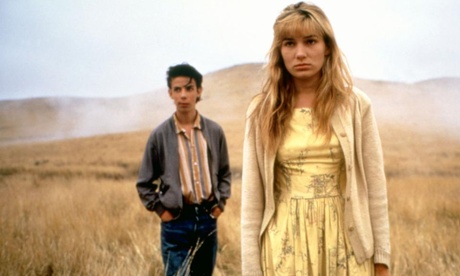
Loene Carmen is Freya, the sort of person often described as a “free spirit” – a peaceful nonconformist who might literally stop to smell the roses. The two teenagers pursuing her affections are played by men who went on to become two of the defining male Australian actors of their generation: Noah Taylor, as the gawky heart-on-sleeve Danny, whose narration anchors the film, and Ben Mendelsohn as Trevor, a foot-to-the-pedal bad arse.
Opening images of the Southern Tablelands capture an orange-hued panorama of small hills and sunny pastures. Freya is leaning against the rocks; we learn through Danny’s voiceover that this was a special and secret place. He and Freya brought blankets and feasts and felt alone there together.
Danny’s parents own and run the local pub (the best and only one in town, as he puts it) which is loaded with the essential components for Aussie watering-hole feng shui: dartboard, grotty counter, specials blackboard and a consortium of sweaty locals. There are familiar looking bar flies, including actors Harold Hopkins and a frazzled looking Graham Blundell (the pair reunited after starring in Bruce Beresford’s 1976 classic Don’s Party).
Danny is picked on at school and derogatorily referred to as poet. The simpletons who prey on him are the Down Under equivalent of atavistic American yokels, the kind of knuckleheads eviscerated by Bill Hicks in his “what you reading for?” skit. Danny has his head in the toilet bowl when he is rescued by Trevor, who is tough and sincere but foolish and brash. His relationship with Freya leads to disastrous consequences and his renegade behaviour, involving crimes and misdemeanours, torpedoes the film towards a dramatic climax.
And yet The Year My Voice Breaks never comes over heavy-handed. The backwoods settings fit beautifully with the themes of Duigan’s screenplay; just as adolescence feels dislocated from adult life, the Southern Tablelands are distant but familiar. Cinematography by Geoff Burton (whose credits include Hotel Sorrento and The Sum of Us) soaks up the small-town tableaux. His images have a homely flair, somewhere between a photograph and a postcard.
Coupled with Danny’s narration, the mood is pensive and ponderous; this is a film as much about watching as remembering. The protagonist’s realisation that he may never see the love of his (adolescent) life again won’t be quickly forgotten – by himself or by the audience.
