
The first week of the new year brings CES. Our annual glimpse into the future, the same future we saw last year, the year before and that seems as far away and far fetched as ever. I’ll save you from another story about drones, 3D printing and wearables. Instead, I’ll focus on what’s actually different this year and what this means for marketers.
Sensors everywhere
The concept of the quantified self isn’t new, but cheaper, better sensors and a reluctance by engineers to either listen to non-existent consumer demand or massive privacy concerns have given rise to a plethora of sensors that can monitor everything that surrounds us and share that information in real time. From smart rubbish bins and portable 3D scanners, to molecular spectrometers that measure the food we eat and wearables that track our mood and brain activity, welcome to an age where everything is monitored, recorded, shared and analysed. I can’t begin to tell you how excited I am by this, until I glance at my watch which conveniently tells me. We talk about big data a lot in advertising, well this is intimate data and it’s amazing to think about what this could mean.
New mobility
Nobody really saw this coming, but CES saw the introduction of a plethora of new ways to get around. From electric scooters that fold to motorised unicycles, to what looks to be a new Segway to the world’s first electronic under shoes, it seems we’ve got personal transportation moving to the next level. They may seem far fetched and maybe these are just a fad, but it’s slowly becoming apparent that with a combination of these lightweight personal travel aids, faster electronic scooters like the Gogoro, a whole world of electric cars and the much read about array of self-driving cars, mean that mobility is being redefined.
Between platforms such as Uber, car clubs offering short-term use, one-way rental services like Hertz 24/7, it’s not a huge leap of faith to imagine a world where owning cars and cars even looking like cars is a distant memory. The notion of vast, heavy chunks of metal spewing out fumes, sitting unused most of the time will seem backwards. These places will also provide new ways to consume media – scooters with large iPad interfaces and self-driving cars that don’t require your attention to drive.
Cognitive outsourcing
The words that surround CES are smart and connected. Everywhere we look we see new types of sensors, new ways to process data and new things to control. From homes that unlock as we walk towards doors and cameras that keep tabs on who is home, to lights that adapt to our needs and to fridges that order food for us, we’re soon to be surrounded by connected devices that work around our needs.
Behold an age where cars drive us around, where televisions suggest content we may want to watch, where our belts tell us how to behave. We could call this the connected home or smarter living, but really this is about reducing the thinking we have to do every day. It’s about us at the centre of a life that just works around us, with technology moving into the background to become ambient and assistive, well, at least before the Wi-Fi router crashes. What’s most interesting about this is what this means for marketers. If machines, algorithms and our toothbrushes are making decisions for us, what does the role of advertising become?
Screens everywhere
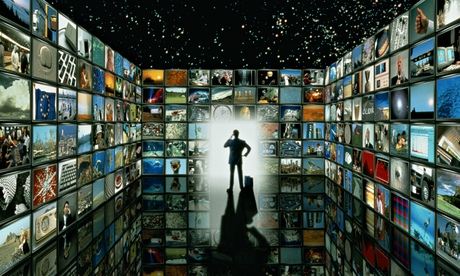
I’ve seen the future and screens are everywhere: smart mirrors in our bedrooms; downward projected images on kitchen surfaces; vast digital retail signage; short throw laser projections; and ultra mobile video conferencing units that chase you around the office. From our wrists to our super large TV’s to our thinner tablets and our connected cars, moving images will become the default unit of communication. Within this world, we need to stop our obsession with the digital divide and focus on the implication of marketing when everything is digital and everything is video. In this landscape the concepts of TV versus video, online versus offline, mobile versus desktop have zero meaning.
Human technology
We’d imagine becoming a cyborg would have looked a bit more futuristic than purple smartwatchs, bluetooth headphones and Fitbits. But slowly and surely we’re augmenting our being with a variety of electronics that makes us a little bit superhuman, so long as we remember to charge them. We’ve got wearables trying to become popular by morphing into potentially luxury fashion items, ceramic necklaces that beam notifications on to your skin, T-shirts that measure our vital statistics and smart belts that judge your food intake beyond the likes of any judgmental friend. If that doesn’t work, we can place Thync’s electrodes on our head and let restful pulses “induce a preferred mental state”.
Vanishing interfaces
We used to control technology with a mouse and keyboard, but slowly the way we navigate content and interact with technology is becoming more tactile, natural and gestural. Amazon Echo was the first device to bring voice activation back in trend, but now we see small startups such as Cubic trying to bring technology to life using our voices. Whether it’s the variety of eye-tracking companies such as Tobii, gadgets such as Ring that let you points and control using fingers, or Myo or Bitbrick as a trackable armband, or even the beloved Leap Motion, technology is becoming more physically bound to us.
Tom Goodwin is the SVP of strategy and innovation for Havas Media. You can follow him on Twitter @tomfgoodwin. He is a speaker at this year’s Guardian Changing Media Summit.
More like this
• From the general election to big data: eight marketing trends for 2015
• Seven shifts that will change marketing in 2015 and beyond
To get weekly news analysis, job alerts and event notifications direct to your inbox, sign up free for Media Network membership.
All Guardian Media Network content is editorially independent except for pieces labelled “Brought to you by” – find out more here.
