You certainly can’t fault Christopher Nolan for his ambition. He’s put together sequences of snow-suited espionage within a character’s multi-tiered subconscious. He’s dispatched heroes back and forth through time-dilating intergalactic wormholes. He’s even got Al Pacino through an entire movie without raising his voice much. He is certainly not a director who could be accused of playing it safe – there’s a lot to be said for that.
But aiming high can only be applauded to a point. Meeting your targets matters, too – and the more giddily ambitious you are, the riper you become for failure. The Dark Knight illustrates this better than Icarus ever could. While Nolan’s film has been largely praised from all quarters since its 2008 release – for elevating the superhero genre to the level of smart-thinking, morally hazy adult cinema – the fact remains that the end result is a clunky, bloated mess.
Thematically, it bites off more that it could ever possibly chew. The lights have barely dimmed before the weighty issues abound: the nature of evil! Law and order versus nihilist anarchy! The justice system versus vigilantism! Post-9/11 foreign policy! Public privacy versus state-sponsored security! The Big Themes are all in there, packed tight as sardines, each one squeezing the life from the other around it.
These are all worthy topics, but they’re all topics worthy of a film to themselves. A third-act subplot tackling the ethics of public surveillance has the raw materials to intrigue and inflame, but in The Dark Knight it’s reduced to a footnote, come and gone before we can process either the storyline or its implications. Notions of ethics, morality and justice should be ruminated on, not rushed along, but The Dark Knight takes them on like a champion strongman in the boulder-lifting round: one after the other, as fast as possible, never pausing for breath.
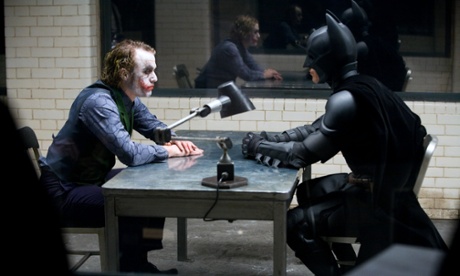
As a result, the film’s ideas are delivered repeatedly and with a bludgeon. “I’m an agent of chaos,” proclaims Heath Ledger’s Joker, as though he’s just arrived home from A-level philosophy. At one point, he engineers an elaborate situation that forces one person’s life to be valued against another’s. Half an hour later, he’s rigged a pair of passenger ferries with explosives to provide us with another protracted set piece that provides the same dilemma. Agent of chaos – we get it.
But at least he’s a bad guy we can enjoy. Ledger is plainly the star attraction, keeping us entertained between all the bat-brooding. Yet the film even plays that hand badly, opting at around the two-hour mark not to start wrapping things up but to introduce a deeply unnecessary second villain. Aaron Eckhart’s disfigured, disillusioned district attorney Harvey Dent might bring some pleasing CGI gore but it comes at the expense of screen time siphoned away from his counterpart.
The grandly assembled cast is another symptom of a desperately uneconomical approach to the quantity/quality conundrum. Employing just one of cinema’s elder statesmen in the supporting cast tends to suffice for most directors. Not Nolan, though, who creates enough peripheral roles for Gary Oldman, Michael Caine and Morgan Freeman all to elbow their way into, the latter two playing the same essential character: Bruce Wayne’s gentle-voiced mentor and moral-compass.
None of this is to mention how bleakly humourless the whole thing is. Bringing seriousness to the comic-book movie is one thing; draining it of all wit is another. Batman is never going to be clinking glasses the fun-loving Ferris Buellers of the world, but rarely has a big-screen action hero operated so many high-powered vehicles with such joylessness.
“Why so serious?” cackles Ledger’s Joker at one point, as the film pauses for a moment of unintentional introspection. Christian Bale’s gravel-voiced antihero – possessing the suit, sound and script of a pro wrestler but none of the self-awareness – is certainly not about to lighten the mood.
If The Dark Knight is a failure than at least it’s a noble one, setting its own bar at a height almost unprecedented for multiplex fare – and making a decent go of the jump, too. But the acclaim and adulation heaped on it over the last half-decade has been wildly disproportionate to its quality.
Once the dour, deafening 152-minutes is up, the film’s plainest lesson is really quite simple: sometimes, less more.
