
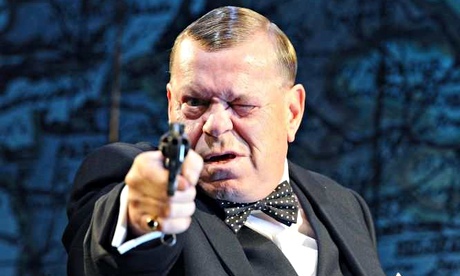
Warren Clarke had a rich and distinguished career in television. I just wish we’d seen more of him on stage: he had weight, presence and real physical authority. It would have been fascinating to see him graduate to lead roles rather than providing, as he invariably did, strong support.
I first became aware of him in David Storey’s Home at the Royal Court in 1970 where he made an impact out of all proportion to the size of his role. Ralph Richardson, John Gielgud, Dandy Nichols and Mona Washbourne were the stars: all occupants of a semi-rural home for mentally ill people. At the start of the second act, Clarke came on and lifted a white table above his head and then did the same with a pair of chairs. His character was clearly as disturbed as the other patients but Clarke’s display of brute strength was belied when he backed off in the face of a challenge by one of the two women. There was something about Clarke’s mix of muscular power and helpless vulnerability that made a lasting impression.
Clarke went on to work for the same dramatist, David Storey, and director, Lindsay Anderson, in The Changing Room in 1971: a brilliant play which used the elaborate rituals surrounding a rugby league game to provide a microcosm of a deeply hierarchical society. Clarke not only looked the part of a rugby player: again he suggested there was a certain innocence about a guy who bought endless DIY equipment to put up shelves to contain his books.
Later, Clarke went on to appear in the West End in an ill-fated production of I Claudius, chiefly memorable for David Warner’s performance as the stammering hero. By now, Clarke was becoming a recognised face in TV and film. He returned to the stage to appear in Anthony Shaffer’s Murderer – another short run – and to join the National Theatre in 1976-77. There he became a part of Bill Bryden’s ensemble in Keith Dewhurst’s adaptation of Lark Rise to Candleford which offered a moving study of Oxfordshire village life in the 1880s.
Looking back, it’s fascinating to note that the company included actors of the calibre of Brian Glover and Derek Newark. Like Clarke, they were burly men of immense power. What made Clarke special was his capacity to suggest that behind the imposing facade lay a sensitive, even troubled figure. I’m delighted that TV recognised his quality: I only wish the theatre had made more use of it.
