The Neapolitan lawyer Francesco Rosi broke into films in the 1950s as an assistant to Luchino Visconti on La Terra Trema (1948), a neorealist epic about exploited Sicilian fishermen. In the 1960s they returned to Sicily to direct contrasted masterworks of political cinema that locate their central figures a century apart in the island’s troubled history – Visconti’s The Leopard in the 19th century of the Risorgimento, Rosi’s Salvatore Giuliano during the struggle for independence immediately after the second world war. Martin Scorsese includes both in his top 12 films of all time.
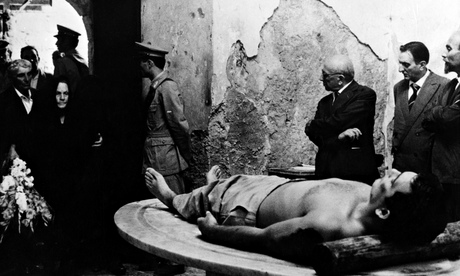
Often described as a Marxist Citizen Kane, Salvatore Giuliano begins in 1950 with an overhead shot of the charismatic 28-year-old Giuliano’s bullet-riddled corpse surrounded by police, magistrates and journalists in a backyard. After our first glimpse of him dead, he’s only seen at a distance, on the edge of the frame, and speaks a mere couple of lines. It is the role of the young, world-famous Sicilian outlaw as a pawn and a power, as a myth and a mystery in postwar politics that Rosi is concerned with, not a personality with an individual psychology.
With the director as voiceover narrator, the film jumps back and forth in time between 1946 and 1951, piecing together the conflict between the competing parties, ranging from the army and the manipulative central government to the mafia, the regional separatists and self-serving bandits. It’s a demanding but rewarding account of competing social and economic interests in a country in turmoil. It is also a thriller with superbly staged action sequences and a fascinating inquiry into Giuliano’s allegiances and alliances.
Shot on authentic locations and played with utter conviction by a cast that features only two professional actors, the film constantly grips through the intriguing narrative (every nod, glance and gesture charged with meaning) and the arresting black-and-white cinematography of the great Gianni Di Venanzo. Rosi has made a number of fine films, but this is his best, and it’s well served in this double-disc Blu-ray version. The restored print and the wonderfully legible subtitles could not be bettered, and the various extras (including a documentary on Rosi and a lecture called The Sicilian Robin Hood) are all valuable.
