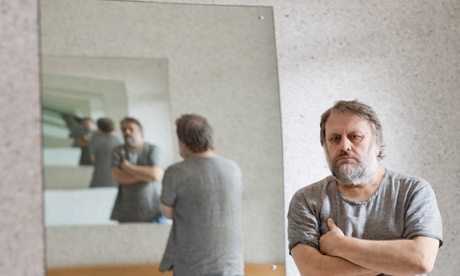
We're ending with a Napoleonic motto – delivered by Slavoj himself
Thanks very much for all your questions and to Slavoj for his brilliant answers. Until next time!
Updated
a0y0y0 asks:
You are defending Lenin and communism and you criticize capitalism, state and liberalism. But you reject the revolutionary potential of the world working class ... Why?
torujordan asks:
“The End of History”, or Fukuyamaism as you sometimes name it, is a concept that appears in a number of your political writings. What do you think is unique about this period in History? And what do you mean by “end”? Is the this an “end” in the sense of a failure of imagination? Is it due to the defeats of the Left from its peak in the mid C20th? Or do you think something is happening with regard to the systemic level of capitalism as a mode of production, to use a term one does not hear very often any more?
 Guardian contributor
 I remember when Fukuyama published his book on The End of History, it was very fashionable to mock him. But in a certain sense, almost all of us were Fukuyamaists. Even the left, most of the left, was not raising fundamental questions, the big questions about the future of capitalism or state. They were just trying to make the existing system more just. And more efficient. And I think the big question today is: is this enough? It is clear, common sense tells us, that we humanity, all of us, are approaching a series of potential catastrophic problems, antagonisms. Ecology, the problem of finances and how to control them, intellectual property, who will control biogenetics, and especially new forms of apartheid in our societies. People say our society is becoming global: Berlin Wall fell down. Yes, but new walls are emerging everywhere, even literally. United States and Mexico, Israel and West Bank. And so on.
Here I want to refer to a rightwing philosopher who I appreciate, the German Peter Slotterdijk. He made a very intelligent observation about globalism. He said that globalism doesn't mean we are all in one big global society, he said that globe also means globe in the sense of cupola, grouping us and isolating us from the rest. Like he was probably referring to films like Elysium, where the privileged elite live under a protective cupola. And this is more and more our situation today. Go to LA: you have the symbolic cupola of Hollywood, Santa Monica, and then you have Inglewood, and literally if you are within the privileged part you are rationally aware there are slums but you don't really see them, they are not part of your world. You just become aware of them when violent riots, protests, explode.
So the Fukuyama problem is: can liberal democratic capitalism, in the long term, can it deal with these problems? I think not, unfortunately. And interestingly enough, even Fukuyama himself is no longer a Fukuyamaist, he admitted that The End of History is dated. So this is the problem today, how even to imagine an alternative. Even Hollywood knows that what is awaiting us, if things go on just the way we are now, is a new apartheid society. Hunger Games, Elysium and so on. But what to do? That remains a problem. I don't have easy solutions here.
CatontheMat asks:
Why are you so down on anarcho-communism? Would you rather put your faith in the dictatorship of the proletariat?
Guardian contributor By anarchocommunism, it is probably meant this appeal to non representative direct democracy, where at the local level, people are directly engaged in solving their problems. I think this is good, as far as it happens, but it doesn't work as the global solution. First thing. Let's take Venezuela, where they did try to implement a grassroots democracy, but the other necessary part of the same project was a strong authoritarian leader who made the terms. This is always a problem with these grassroots movements. They are fine up to a certain point and then you cannot go further and the problem today, for me, is precisely how to go further. What we need are large decisions, actions, and so on. To fight ecological threats for example, it's not enough to organise in our local communities recycling and so on. We need in the long term radical restructuring of our entire industrial civilisation.
The second problem I have with this grassroots participatory democracy may appear just a personal one. But I think there is a universal truth in it. Can you imagine living in a society where you would have to be engaged all the time in some stupid local problems? Debating this and that, how to organise healthcare, schooling, parks, whatever. It would be hell. I want a certain degree of alienation. I want some nameless agency just to do these relatively efficiently, so that things function, and I can do what I really want to do. Read books, watch good movies, and so on. I don't think that active participation of the majority should be kept as an ideal, it is something that works only in states of emergency.
JovialMerchant asks:
What does Zizek think about Thomas Piketty’s proposal for a global progressive tax in order to reduce inequality? Does Zizek think this is a valid and worthwhile goal for the new left, or is it a futile waste of time?
Guardian contributor As with everyone I of course admire Piketty's book. But I think that his solution, raising the taxes for the rich, is utopian. Why? For two reasons. First, Piketty is very clear about this point. He think capitalism is the only system that works. So he wants to keep the capitalist dynamics but just make it more just through higher taxes. I think in today's global capitalism you cannot do this. So would have to have some kind of global government which would be able to impose these higher taxes universally. But if we have this then we, radical left, already won. Then we no longer live in the same capitalist world. So Piketty's solution presupposes that we already won.
Next point: even if, let us say, some social democratic government were to introduce higher taxes, in order to elect and maintain this measure other changes will have to follow. You cannot have capitalism the way we have it, just with higher taxes. And here I see the problem. I am more of a pessimist - this doesn't just go for Piketty, this goes for Paul Krugman, Joseph Stieglitz and so on. Yes, we should begin with what they propose, but we should be aware that this is just the beginning. And the problem is what comes next. Where much tougher measures are needed.
His thoughts on a boycott of Israel
jemurphy asks:
Is an academic boycott of Israel justified? Do you support a boycott?
Guardian contributor I do support academic boycott, but only Israel's state institutions. To boycott Israel in the sense of not visiting it, not having contact with people there, I totally reject this. The reason is double. First, there is recently in Europe a new wave of anti-semitism. For example in countries like Hungary, Slovakia, Poland and others. So for a European who remembers the Holocaust, anything to do with boycotting the Jews brings out terrible memories. We are playing with fire here.
But nonetheless, the reason why I support a boycott, BDS and all that, is that it is a common project of Palestinians, and Jewish progressive critics of Zionism. This unity is absolutely crucial. The moment we abandon this unity and say oh no, Israel is so bad that we have to be directly against Jews, we all deserve to die. Life is over for me.
And another thing which is important and which people tend to forget: boycott is a non-violent measure. Better boycott than terrorism, than bombs. So although I am absolutely on the Palestinian side, I think we should be very careful to make Palestinian resistance into part of a modern universal emancipatory project. Without this we are lost.
Updated
kulusedada asks:
Stravinsky or Schoenberg?
Guardian contributor Of course, this question probably refers to Adorno's book of philosophy on new music. And I agree with it totally. I am against Stravinsky, for Schoenberg. I think that when we get a breakthrough in art, like with Schoenberg, we always get then accompanying it, a figure like Stravinsky. Renormalising the breakthrough. Cutting off the subversive edge of the breakthrough. And I think again the same goes for other arts, for example, in modern painting, it would have been Picasso vs Braque. I think Picasso is Stravinsky in painting, with his eclecticism, while Georges Braque is the thorough modernist ascetism. Even in literature, although the homology is not perfect, I'm tempted to say Joyce vs Beckett. Joyce is I think too bright for his own good. It's too pretentious in this encyclopaedic approach, like using all languages in Finnegan's Wake; the true genius is for me Samuel Beckett. If I were to choose one novel of the 20th century, it's his Unnameable. I think that the three absolute masters of 20th century literature are Beckett, Kafka and the Russian Andrei Platonov. If you put the three of them together, I'm ready to burn, sacrifice all other books just to keep these three. I think even much of high modernist writing is overrated. For example, if I were to choose between Virginia Woolf and Daphne du Maurier, I would immediately choose du Maurier. We shouldn't be afraid to admit this.
Brandon Jones asks:
You seem to be friendly with Peter Sloterdijk’s ideas about contemporary cynicism. Do you buy his argument about “kynicism”, more reminiscent of ancient Greek Philosophical Cynicism, as the remedy to contemporary cynicism? If so, what does this look like?
Also, how much has Oscar Wilde’s The Soul of Man Under Socialism influenced your own work? It is my favorite book and I saw that you made direct reference to it in the RSA Animate video First As Tragedy, Then As Farce. I even read your own book of the same name for this reason.
Do you think modernist philosophy has become completely unhinged from the love/pursuit of wisdom, as the Greeks understood it? All theory and never any application, not unlike people like Nietzsche, Marx and Wittgenstein argued? How do you understand the love of wisdom? What, if anything, can or should be done about the way in which modernist thought has created a situation wherein people think they need a reason to care about people?
Lastly, I am a young American philosopher that does not buy into capitalism, democracy, or many other dominant paradigms of American life. I am miserable. My pain is constant, and sharp because I am forced to live in this, as you call it, “permissive totalitarian” country. Do you have any advice on how people like myself can overcome this and find some way to live well?
I am one of your biggest fans, and while I realize this might actually cause you to despise me, I just wanted you to know that I am always cheering on your endeavors and I wish you all of the success in the world – though you have achieved so much already.
Guardian contributor I think yes, it has become unhinged from the pursuit of wisdom, and I think it's the best thing that could have happened. Wisdom is basically a conformist stupidity. The best embodiment of wisdom are proverbs, and with them you can justify everything. If you take a risk and then succeed, there is a proverb. If you fail, you have another proverb, like in our language, it is: you cannot urinate against the wind. That's wisdom. The ultimate lesson of wisdom is don't try too much, don't aim too high, at the end everything ends up in dust. But I think for example Christianity, and I define myself as a Christian athiest, Christianity is not wisdom. From a standpoint of wisdom, it is madness. It's the hope that a radical break can happen, we can be redeemed, and so on. So I think that all today's form of wisdom, usually new age wisdom, although they pretend to open up a way, to save us from our crisis, they only deepen the crisis. Wisdom is one of the names of our enemy today.
"Philosophy will become more important than ever"
Omar Bitar asks:
What is the future of philosophy – both within academia and in the so-called “collective consciousness”?
Guardian contributor I think philosophy will become more important than ever, even for so-called 'ordinary people'. Why? The incredible social dynamics of today's capitalism, as well as scientific and technological breakthroughs, changed our situation so much that old ethical and religious systems no longer function. Think about biogenetic interventions, which may even change your character, how your psyche works. This was no even a possibility considered in traditional ethical systems, which means that we all in a way have to think. We have to make decisions. We cannot rely on old religious and ethical formulas. Like: are you for or against biogenetic interventions? In order to decide, to take a stance, you have somehow implicitly to address questions like: do I have a free will? Am I really responsible for my acts? And so on. So I think that 21st century will be the century of philosophy.
Updated
ID4857742 asks:
Professor Žižek:
What is your opinion of this week’s controversy and discussion in the US about the nature of the Islamic “threat” to Western societies and whether the threat is not only from the radical jihadists, but also includes most--if not all--of moderate Islam, which tacitly supports Jihadists or at least does not oppose their beliefs and intentions, and which supports the subjugation of women in their societies, including genital mutilation. The Quran and most of Islam seems to support censorship and execution of Danish cartoonists and the death penalty for “apostasy.”
It has been stated that Islam “is the motherlode of bad ideas.”
Do you in any way agree with this statement?
Thank you,
D.L.
Guardian contributor First as to the threat to Europe. The real threat to Europe is not an external one. Islamists or other external enemies, it comes from within. It's the anti-immigrant populism which on behalf of defending Europe rejects precisely what is worth fighting for in the European legacy. As for Islam, I think it's basically the same as with other religions, all religions are opportunistic. Their founder usually said some great things about love and tolerance, but then just to make it safe, he added something about the right to kill those who don't believe. Like Christ said, love your neighbour, but then also said I don't bring peace, I bring war. So to be very clear, I do totally oppose today's Muslim fundamentalism.
But with a couple of additions: first, we should be aware that we also have in our highly developed societies, our own Christian fundamentalism which can also be violent. According to the FBI, they have 2 million Americans under observation, as potential Christian fundamentalists. So the problem is what is it in today's capitalism that generates fundamentalism?
Second point: it's interesting to look a little bit at the history of Islam. For example today of course, the position of women at least in many Muslim states is intolerable for us. But in medieval times, the position of women in Muslim states was at least marginally better than in Europe of that time. As for tolerance, and anti-semitism, I remember that in ex-Yugoslavia, the only city with really large percentage of Jewish population was Sarajevo. Why? Because the Muslims tolerated them, in contrast to us Christians! So again, I do not reject analysing how today's fundamentalist violence is justified by Muslim fundamentalism. I think it's the same as with paedophilia and the Catholic church: I'm just saying we have to be historically specific, and we have to apply the same criteria to all religions.
DamienEngine asks:
Why did you get it so wrong about the UK riots? Why can’t the rioters’ control of the streets and the shops for a night be seen as political? Maybe not to your schema, but nonetheless...?
Guardian contributor The question asks: why can't the rioters control the streets at least for a night? That's precisely the problem for me. I think it's easy to have this ecstatic carnival-like uprisings, which last for a short time, and then a little bit later things return to normal. The measure of a successful revolution or revolt, is what happens a day after. How do ordinary people feel the difference, when things return to normal? That's why I don't like carnivals. I like order and discipline. I like changes in everyday life, I don't like big ecstatic moments that we then afterwards remember fondly when we return to our everyday corruption. So this is what I was missing in the UK riots. Even a minimal positive vision. To put it in an even more brutal way, if I were to be a member of some secret capitalist organisation, trying to discredit the left, I would have organised and financed precisely such riots.
BatesBasement asks:
Dear Slavoj,
How is your recapitulation of Lacan’s point that desire’s principal aim is to reproduce itself different from Schopenhauer’s Will, a philosopher largely absent from your oeuvre?
And given this formulation, how can we not agree with Adorno that there is no room on Earth for all our desires, that we seem to be tragically programmed to exhaust the natural world and witness the terrifying clash of the infinite restlessness of self-conscious beings with the finite resources available to us?
Thank you for your work
Guardian contributor I don't see any continuity between Schopenhaeur and Lacan. I think Schopenhauer is at the origins of the rationalist philosophy of life which has nothing to do with the Freudian unconscious. The Freudian unconscious is rational, articulated, structured like language. Schopenhaeurian drive is life drive, while the Freudian drive is death drive. And in the opposition between life and death, I'm for death. That's why I love Von Trier's Melancholia - all life on Earth disappears, so I think it's a film with a happy ending.
Vivieen Sanchbraj asks:
Is happiness important these days? How can we be happy? What steps do you suggest?
Guardian contributor Happiness was never important. The problem is that we don't know what we really want. What makes us happy is not to get what we want. But to dream about it. Happiness is for opportunists. So I think that the only life of deep satisfaction is a life of eternal struggle, especially struggle with oneself. We all remember Gordon Gekko, the role played by Michael Douglas in Wall Street. What he says, breakfast is for wimps, or if you need a friend buy yourself a dog, I think we should say something similar about happiness. If you want to remain happy, just remain stupid. Authentic masters are never happy; happiness is a category of slaves.
ChrisPrendergast87 asks:
What do you think we can learn from cats, if anything?
Guardian contributor Nothing. I like to search for class struggle in strange domains. For example it is clear that in classical Hollywood, the couple of vampires and zombies designates class struggle. Vampires are rich, they live among us. Zombies are the poor, living dead, ugly, stupid, attacking from outside. And it's the same with cats and dogs. Cats are lazy, evil, exploitative, dogs are faithful, they work hard, so if I were to be in government, I would tax having a cat, tax it really heavy.
Reality14 asks:
I am interested in how you would characterise boredom. When large proportions of the population declare themselves bored by, or bored with, or express other forms of ambivalence about politics (that is, liberal democracy - it being all we have), is this suggestive of something other than cynicism (however you might define that)?
Guardian contributor I think boredom is the beginning of every authentic act. Kierkegaard, one of my favourite thinkers, wrote that it is out of boredom, boredom of being alone, that God created the world. Then Adam was bored, so God created Eve. Then lonely people got bored, they created communities. Then we, Europeans, got bored, we engaged in colonialism. Now we are bored on our Earth, we want to travel into space. Boredom opens up the space, for new engagements. Without boredom, no creativity. If you are not bored, you just stupidly enjoy the situation in which you are.
Igor Stojanov asks:
Do you think that the objectivist philosophy of Ayn Rand, especially her ideas on ethical egoism and laissez-faire capitalism should be more widely accepted in the western world?
Guardian contributor I must say I appreciate Ayn Rand. Of course I totally disagree with her. But what I like about her is what I call over orthodoxy, every ruling ideology can only function if it doesn't say it all. Like no capitalist today will openly say: egotism is good. They try to cover up the position as ethical for the good of community but Ayn Rand goes to the end. She plays the same role with regard to capitalism as for example Malebranche does with regard to Catholicism, or Kleist does with regard to German militarism. They are all an embarrassment for the ruling ideology. Precisely by bringing out its secret perverse core.
"I am not myself. I do all my work to escape myself"
rhythmic88 asks:
Thank you Prof. Zizek for taking the time to do this interview.
Q: What is it like to be you?
Q: What are your conclusions on Zen?
Q: What are your thoughts on meditation, especially in relation to the scientific studies? If you do not meditate in light of the findings of recent studies, why not? There is a Zen saying which states that if you are too busy to meditate for 20 minutes then you should meditate for twice as long!
Guardian contributor I don't know because I am not myself. I do all my work to escape myself. I don't believe in looking into yourself. If you do this, you just discover a lot of shit. I think what we should do is throw ourselves out of ourselves. The truth is not deep in ourselves. The truth is outside.
Regarding Zen, this is also the cause of my ethical disagreement with Zen Buddhism. The way Zen Buddhism is perceived today is as telling ourselves we must not throw ourselves fully into reality, that we must not attach ourselves too much to earthly objects. Since external reality is just a flow of appearances. I believe on the contrary, that we should fully attach ourselves to earthly objects. If you write a book, forget about everything else, throw yourself into it. If you are in love, go to the end, sacrifice everything for the object of love. This is why we today no longer want to fall in love. We want it controlled, like safe sex. But what I like in love is precisely the fall. I feel alive only when I fall. And this goes up to the beginning: I think Hegel already knew that Adam's fall was the greatest achievement, the greatest event in history.
Updated
bhanuk asks:
Dear Mr. Zizek, is poetry dead? If so, what killed it? If so, what might revive it? In this formulation, poetry becomes a zombie on wheels. Not good. What might reverse the death that poetry knows is coming? Bhanu Kapil
Guardian contributor It's not dead, but it's heavily wounded and it's its own guilt and responsibility. The more I look at the genesis of modern cases of ethnic cleansing, the more I discover that there always is a poet who did the preparatory work: in Bosnia, Rwanda and so on. Stephen Weinberg said that you need something like religion to make good people do evil things. I think poetry can also do this, with its strong ecstatic vision it can blind you for the horrors of what you are actually doing. So I think when Plato banned poets from the city, he had a point.
MrSvejk asks:
The online battle for the control of news is being fought and won by state and corporate power elites, so that this becomes the accepted historical account of today’s reality. How important is wiki leaks and other whistle-blowers in restoring peoples trust that a truthful version of reality can exist?
Guardian contributor I think that the latest Wikileaks revelations, of so called Disa secret agreement, are crucial here. They show how while we experience ourselves as free, you read what you want, your love life is your own, you can invest your money how you want, but all this free choices take place within a framework which is more and more obscure and out of control. I think that the more we are free as individuals, the more the complex social network controls us. And here is the the role of whistleblowers. Now let me be precise: I am well aware that we suspected what we learned from them, basically we didn't learn many new things, more or less. But in our daily life, we preferred somehow to ignore this knowledge. I want it out of my sight. The greatest achievement of Wikileaks, is that we ordinary people are no longer allowed to pretend that we don't know.
Slavoj is with us now
Slavok Žižek is here and has started answering your questions. BoldSammy asks:
Hi Slavoj. I very much enjoyed your talk on liberty in the West last night. I know you prefer to talk about global themes, but there was one very real opportunity for change recently here in the UK - the Scottish referendum. It may have been change for better or for worse, but people were at least able to imagine the impossible: a radical, if undefined, alternative to neoliberalism. From a post-Yugoslavian perspective, do you think that the left’s willingness to rely on civic nationalism is liberating (as it felt to many of us) or a constraint? You repeated last night that the problems with capital are global. Do you think the solution is global or local?
Guardian contributor I know there is a division here between leftist thinking that we need local points of resistance, and those who think the solution also has to be global. I unambiguously side with the second option. The solution has to be even more global. Resisting local cultures perfectly feeds global capitalism, they just help local populations to fit better global capitalism. An example: the new PM of India, Modi, he wants India to embrace more radically global capitalism, and he is a Hindu nationalist. That's the paradox we should get.
Updated
‘Pop philosophy’ has a whiff of shallowness about it, but Slavoj Žižek is one of the few thinkers who has broken out of the library without sacrificing his academic and political credibility. For Žižek, stasis is the enemy. Ideas, and indeed our entire way of being, must instead be batted around until they gradually become sleeker, rather than staying stock still in moral absolutism.
In his new book Absolute Recoil, the Slovenian philosopher directs this approach towards Hegel and Marx, wondering if the foundations of their progressive thought – which has underpinned his own throughout his career – could be rebuilt, or at least updated for an age of fresh sexual and societal problems. In other books, he applies these ways of thinking to film directors like Alfred Hitchcock or David Lynch; he also frequently wades into the cut and thrust of everyday society, be it considering the Occupy movement or the sexual abuse cases in Rotherham.
The scale and vitality of his ideas mean that there is a huge amount to quiz him on when he joins us for a live webchat and answers your questions. Post them in the comments section below and then follow the conversation live from 2pm BST onwards on Wednesday 8 October – he’ll endeavour to answer as many as possible.
Slavoj Zizek will be speaking at Royal Festival Hall on the 7th of October
Updated

First, I'm not defending Lenin. I'm just saying that October Revolution was an authentic emancipatory event. But at the same time I'm well aware, that Stalinism was from the very beginning inscribed at least as a possibility in October Revolution. Second, I don't just criticise liberalism. I have great appreciation for the freedoms about which liberalism is talking. I'm not repeating this old pseudo-Marxist point that we just have formal freedoms, but not actual freedom. Form matters. When we are formally free, only then we become aware how limited this freedom actually is. The problem is effectively who is a possible agent of change today. It can no longer be the traditional working class. Because to be a traditional worker, let's say I'm employed by a big factory or company and I have a safe long term job. Ok, I am exploited, but in a stable way. This is almost a privilege today. What about permanently unemployed. What about precarious workers? What about all those living outside of our cupola, our universe? So the only agency of possible change I think can rise with the combination of all these dispossessed, marginalised and so on. Illegal immigrant workers, permanently unemployed, those living under ecological threat, the task is to somehow join all these multiple points. And there is no Marxist teleology that guarantees the success. Maybe we'll just go on and end up in a new apartheid nightmare. But nonetheless I'm not a total pessimist. I think that strength comes only from admitting defeat, or the full extent of the crisis in which we're in. We have to become aware, finally, that the 20th century is over. All 20th century answers to capitalism no longer really work. With regard to Stalinist communism, it's a supreme ironic fact that where today communists still in power, they are the most efficient ruthless managers of capitalism. The ideal place to be a capitalist is China: they control trade unions and guarantee workers will not rebel.
Unfortunately I think the era of social democratic welfare state is over - it is only possible in strong nation states. But today with the free global flow of capital, it's almost impossible for a nation state to guarantee the condition for universal welfare. Then as I already said, I think the appeals to grassroots democracy don't work.
But this is not all the truth. There are multiple signs that something new is possible. Let me conclude with one example. Free downloading. Aren't we almost entering communism there? Even DVDs are disappearing. I think capitalism will not be able to integrate so-called intellectual property. Intellectual achievements are in their very nature communists, able to circulate freely. And this free availability of products is already opening up a non-capitalist space, even if it is the product of the most advanced capitalism. Again, just look for the signs. There are signs of an alternative. We just have to be patient and wait. We should act, but not in the old Marxist way that we are instruments of higher historical necessity. We should fight all our struggles, against sexism here, racism there, and so on. But we should nonetheless keep open a sense of risk. There is always a mystery in political activity. You think you are engaged in a big project and nothing comes out of it. But often you make just a small demand, and if you insist on it, everything changes. We cannot master in advance the consequences of our acts. We should act and keep our mind open.
So let me finish with a militaristic phrase from Napoleon: on attack, then we shall see. That should be our motto.