
At a Siemens press conference earlier this week I sat next to a public relations executive from the Austrian branch of 3G network Three. She told me how many handsets Three has sold in Austria, how popular the key applications like video calling and video downloading have proved to be, and how Austria is the only country in the world with two competing 3G networks.
After finishing her spiel, she then turned to me and asked: "Why is the press in the UK so negative about Three and 3G?"
I thought of telling her about a botched launch with a network that did not work properly. Of ridiculous targets that the network had set itself - one million subscribers by the end of 2003. Of stupid restrictions on handsets, which means that owners of Three's flagship phone, the Motorola A920, can't access the full internet, just a small selection of sites. (Austria's Three subscribers get full Internet access.) And most of all of how disappointing the handsets themselves have been.
Instead I just smiled and said the opposite was true now and that in the great British tradition of rooting for the underdog, the UK media seem to be warming to Three.
To be fair there are many good reasons why Three is starting to get a better press. I have heard plenty of anecdotal evidence from friends with Three phones that the network is starting to function properly. Three has also launched some interesting new services, such as enabling users to make video calls to Three subscribers in other countries including Austria and Italy. It now has Champions League as well as Premiership football highlights, and music fans can download the latest pop videoes courtesy of MTV.
Finally the company seems to have availed itself of some interesting handsets. Early models, such as the clamshell NEC e606, worked reasonably well. But that phone had many drawbacks in that it was a tad large, had an impenetrable interface and relied on putting on a headset to make a video call. Other NEC phones were even bulkier.
There are phones on their way that have the wow factor the early handsets lacked, however. Here is what the company is lining up for the end of this year and the start of 2004.
Motorola A920
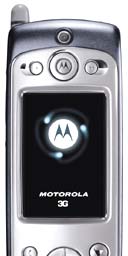
The A920 is the flagship of Three's handset range. It uses the same Symbian operating system as found on the Sony Ericsson P800 and Nokia 3650. This phone's video performance, both in terms of video calling and playback of downloaded clips, is vastly superior to other Three phones. To make the most of this, it sports a huge screen that can used in either portrait or landscape mode. Another key facility is AGPS (Assisted Global Positioning System) which enables the handset to show maps of how a person can find a route to a restaurants, cashpoints and so on. From a phone lover's perspective it would be the perfect phone were it not so large.
Motorola A925
This handset tackles the A920's biggest weakness in that it offers all the same features of the handset, but in a significantly smaller frame. It may arrive in the UK before the end of the year.
Motorola A935/Siemens U15
Give or take the slightly different styling and interfaces these are essentially the same phone. The models both have plenty of features including video calling/ video download (at rates that are superior to the early phones but not as good as the A920) AGPS, MP3 and video playback. The phone is smaller than the A920 and could appeal to those who like chocolate bar-style handsets. The Motorola version is due any time with the Siemens handset coming next month.
NEC e616
This is the successor to the clamshell e606 which, by some distance, has been Three's most popular phone. The updated version is smaller and lighter than its predecessor and boasts better battery life, which was one of the major criticisms of the 606. It also has a colour screen on the front. Crucially it can switch between GPRS and 3G networks, enabling Three subscribers to send images and check their email in areas where there is no Three video coverage. It should be available next month.
LG U8100
The LG U8100 proves that 3G phones don't have to be huge. This small and light handset looks and feels more like a GPRS camera phone than a 3G video model. LG has crammed many features into its compact frame including video calling, video capture and playback, MP3/AAC music, Bluetooth and Java. It is launching in the UK early next year, almost certainly through the Three network.
Motorola V1000
Motorola's V range of compact clamshell phone will embrace 3G with this model early next year. Almost certain to be available via the Three network, the V1000 has two cameras (for video calling), two displays, and an internal antenna.
And one Three won't be touching ...
Nokia 7660
An unusual tear-shaped 3G handset that is crammed with entertaining facilities. It does not, however, feature Three signature application video calling, so the network almost certainly will not be offering it. It might be available though other networks with as a GPRS phone.
