
There was a time when kitchen gadgets meant odd-shaped corkscrews and fancy cocktail shakers. Not any more though, for after taking over your study and harbouring designs on your living room, the PC is hoping to cook up a technological feast in your kitchen.
Not that the concept is about rustling up PowerPoint presentations while you add parmesan shavings to your salad. Rather, manufacturers have got their eyes on the space in your kitchen currently occupied by your TV, hi-fi and even the message board on your fridge.
In the future, your new kitchen-friendly computer will connect to your home network, offer access to your library of MP3 music tracks and videos, as well as giving you the chance to peruse an online newspaper, check your e-mail or find out who in the family is doing what via a virtual calendar. All while you tuck into your corn flakes.
And the kitchen PC will obviously be a world away from the buff-coloured box in your study, both in terms of design and usability.
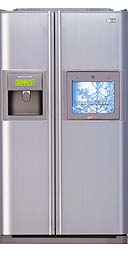
Integrating PC technology into devices is the strategy favoured by Korean brand LG Electronics. Three years ago it debuted its infamous internet fridge, a huge American style cool-box that featured an integrated entertainment-style computer. For £8000, owners could check their e-mail, surf the web and watch TV all on the LCD screen on the front of the fridge.
Reputedly snapped up by Premiership footballers and rock stars, the fridge is apparently still selling well and can now be picked up for less than £6000. For such a high-tech device it uses a rather ancient operating system (Windows 98) and has a processor running at just 133Mhz - less than almost all PDAs.
LG is still very proud of the product. "It is a good example of how our company's strengths in different areas could be used to create one innovative product," says Andrew Mullen, LG's new product development manager. "And we are constantly looking at ways of developing products in this area."
Mr Mullen promises that in the future the fridge will be able to connect to a security camera so owners can see who is knocking at their door. There are also third party developers working on applications for the fridge. "So, for example, the fridge might be able to create a virtual shipping list which it then automatically e-mails to an online shipping store," he adds.
LG is also working on variations of the fridge, though it could be some time before they come to market. Mr Mullen does believe, though, that within a decade, internet access and entertainment facilities will be a staple on all fridges bar really cheap models. "Once you've got people paying £150-£200 over the price of a standard fridge for these features it becomes a mass-market product. They get all the functionality and save space in the kitchen which would otherwise be occupied by a TV or hi-fi."
In October, the fridge will have some fairly serious competition as US manufacturer Beyond brings its Icebox to the UK. In spite of its name the Icebox has no food cooling facilities. Rather it is PC specifically designed to be installed in a kitchen. Its owners then view TV programmes, DVDs, or surf the net on its drop-down 12-inch LCD screen.
"This is a product that is targeted at women, not techies," explains Graham Drage, the business development director for Beyond Europe. "It is a kitchen appliance, not a consumer electronics product, and that's why we have made it so easy to use."
Having lived with the Icebox for a week I can see what he means. Its features can be activated in number of ways - through its remote control, via the unit's touch screen using a stylus or best of all from a wireless keyboard which, if you spill your coffee on it, can be cleaned just by running it under the tap.
It is easy to set up too. The Icebox connects to the net either as part of a network via its Ethernet socket or through the phone line using a dial-up connection. We hooked it up to Netgear's Wireless Ethernet Bridge and got online wirelessly.
It has a few weaknesses. It won't stream audio and video - bad news for an internet radio buff like me. Also its version of Internet Explorer only allows for three pages to be seen - tricky if the site you are visiting foists pop-ups on you. There's very little storage too so you can't, for example, keep MP3 files on its hard disk. Yet these are relatively minor quibbles.
It certainly isn't the finished article and at £2300 it is way too expensive for average punters. But it clearly shows how kitchen entertainment systems might evolve.
"I am convinced systems like this are the future," adds Mr Drage. "The fridge is not always in the right place for people to view the screen, so I think standalone products are much more convenient. I would imagine that within a few years, 50% of homes with have a product like this in their kitchen."
While checking e-mail in the kitchen sounds very useful, you can't help but wonder where it will all end. I suggested to Andrew Mullen that LG, which has washing machines, microwaves and air-conditioning systems that can be controlled via the net, was probably working on an internet toaster.
"Well, how about a toaster that printed the weather map on your toast?" he replied. I am not entirely sure if he was serious, but I can just imagine the prospect of light winds having to deal with the impact of incoming Marmite.
