
You can tell a lot from rules and regulations. At Insomnia44 ("the UK's largest gaming festival") you are not allowed to bring your own fridge, or your own grill. You are also forbidden from sleeping at your desk – they are laid out in rows for the computer gamers, as at a call centre. However, less repressively, you may have food delivered to you as you play. Not moving, I deduce, is considered desirable.
So far, so much very unlike Glyndebourne, which is about my comfort zone in the festival world. I have never played a computer game, leaving aside a brief recent flirtation with something called Fruit Ninja – one slices fruit very quickly on an iPad – which left me hyperventilating and overexcited. (In short, if that's too rich for my blood, God help me when it comes to blowing up dragons, or whatever one does in proper gaming.)
"You are," says Craig Fletcher, managing director of Insomnia44, "one of the 40%." The 40% who don't game, that is. Computer gaming is one of those things that you are either inside or outside the circle of. To those outside, it is generally regarded as antisocial, potentially violence-inducing and an obstacle in the way of young people getting some fresh air. For those inside – well, I am here to see what the fuss is about.
As I arrive at the International Centre in Telford, Shropshire, young people are steadily trickling in. They are mostly in their early 20s, many staggering beneath the weight of their computers, which they have brought with them. There's a uniform: absolutely everyone is in jeans and a hoodie. But they seem bright and, as it were, fully in command of the basic social graces. And there are women! A few, anyway. Inside the unprepossessing shed that is this Midlands convention centre, there is a cavernous hall where up to 1,000 people can play games. They look set for the long haul: carrier bags groan with snacks and energy drinks. Someone has put up an artificial Christmas tree. This festival is, I am told, small: the summer iteration is three times as large, says Fletcher, and next week 12,000 are gathering for a similar event in Sweden.
Another hall is set up with a big screen and spectator seating for several hundred: this is where, I learn, enthusiasts gather to watch tournaments; gaming is increasingly becoming a spectator sport. (There's an international league, owned by NewsCorp.) A prize of £20,000 is up for grabs this weekend for the winner of a Starcraft tournament. This, I am told, is a game of strategy – "like chess", says Michael O'Dell, who manages a team of professional gamers called Dignitas. David Treacy explains that you have first to build your economy, then create an army, and then go into battle. Treacy, 27, a willowy, articulate fellow, is a Dignitas pro, one of the best. Which, in the UK, doesn't mean vast riches (unlike in South Korea where, according to Fletcher, "players are flown in choppers to stadia and watched by 60,000 people"). Treacy plays under the name Zaccubus. I also meet Wizzo, Lumpy, Dream, Dopey and Bashful. OK, so I made the last two up. But I did meet Total Biscuit, who commentates on the big matches.
Why do people come? Stephen Kavanagh, 23, a philosophy student from Cork, tells me it's to meet up with the buddies he usually plays with online – "You can play anywhere, but interacting in person is a million times better." Chris Enderby and Ross McCall, both 21 and from Edinburgh, agree: "We want to be part of this environment. People think of gamers sitting alone in their rooms, but this is social." Becky Millington, 21, a waitress from Walsall, came with a dozen friends and, she says cheerfully, she will "play until my eyes can't see any more".
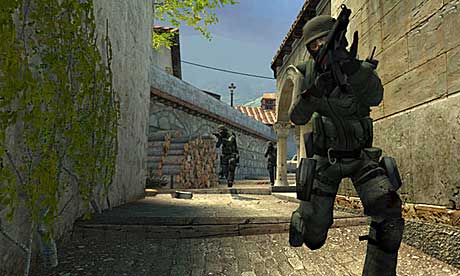
I decide to attempt Counter-Strike. The setting is some kind of vaguely Middle-Eastern walled compound, with palm trees visible above stone walls. I have to shoot another guy before he gets me. We are, notionally, a terrorist and a counter-terrorist. O'Dell kindly offers to "switch off the blood" but I think I can grasp the difference between fact and fiction. There's something intensely familiar about the visual environment; finally, I realise that the backdrop (the walls and palms) were referenced by Dexter Dalwood in his 2010 painting White Flag, shown in last year's Turner prize exhibition. When I see the experts play their concentration is total, their fingers flashing over the keyboard as if playing Chopin. I, needless to say, am dead in seconds.
