
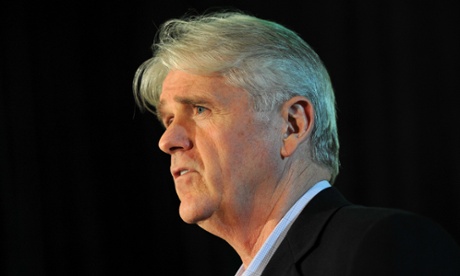
NBN Co chief Bill Morrow says the government knew about his involvement in a lawsuit over one of the largest utility disasters in California’s history when he was appointed to the role.
Pacific Gas and Electric, where Morrow was chief executive, stands accused of putting profits before people’s lives after two separate pipeline explosions in 2008 and 2010 killed nine people.
Morrow, who left the company before the disasters, said he would defend the lawsuit vigorously.
Morrow is named with 21 other executives in a consolidated shareholder derivative lawsuit that alleges the company was “grossly under-spending on operational and process safety creating a situation where a catastrophic incident was not only possible, but highly likely”.
In a Senate estimates hearing on Thursday evening, Morrow said the government and NBN Co were aware of the lawsuit when they hired him last year.
“I will continue to vigorously defend the proceedings. I believe that when the legal process runs its course, it will confirm that my fellow directors, officers and I acted with care, in good faith, and in the best interests of PG&E at all times,” he said in his opening statement.
“I was upfront about these issues when I spoke to both the board of NBN Co and the government during the recruitment process for the role of CEO.”
Morrow, who joined NBN Co at the end of 2013, said PG&E addressed the issues involved after the accidents and compensation was provided to families and communities.
He said a shareholder derivative lawsuit typically names all of the senior officers and directors of a company.
“This case is no exception. The parties that are named in the shareholder actions include virtually every person who was a director or senior officer at PG&E between 1995 through 2013. My name is one of 20 that were named even though I was only employed by PG&E for two years that began in August 2006 and ran through August 2008,” he said.
Morrow told Senate estimates he was not directed to prepare the opening statement which address the legal proceedings and had consulted legal advice within NBN Co and PG&E after drafting it.
He said in the two years he served at PG&E it provided “safe, reliable and affordable energy” and increased spending on maintenance.
“In the meantime, the legal process rolls on. As the matters are still before the US courts, which I must respect, I am unable to comment any further – other than to make one final important point: I regard safety as paramount,” he said.
Marrow said reference had also been made to a US government action against PG&E but no officers or directors of PG&E have been named in that matter, including himself.
“In fact, the company has denied that any PG&E employee knowingly violated any relevant federal law,” he said.
On 24 December 2008 a man was killed in Rancho Cordova, California, after a teenage girl lit a cigarette, triggering a massive pipeline explosion that injured five others.
The state gas industry regulator, the California Public Utilities Commission (CPUC), ordered PG&E to pay a $38m fine in 2011 following an investigation that found the pipeline was weaker than allowed by safety regulations, and had not been pressure tested.
In 2010, another pipeline explosion in San Bruno killed eight people and destroyed or damaged more than 100 homes.
Investigators found many of the same problems in the Rancho Cordova explosion had triggered the 2010 disaster. The San Bruno explosion is characterised in numerous reports as one of the largest and most deadly utility disasters in California history.
An investigation of the San Bruno event by the National Transport Safety Board blamed PG&E’s “inadequate pipeline integrity management program”, which failed to find or fix a faulty pipe section that had been laid originally in the mid-1950s.
For its part, the CPUC has roundly criticised PG&E for inadequate safety practices, internal cost-cutting practices outside industry norms, and the alleged diversion of maintenance funds to executive bonuses and shareholder returns.
But various detailed investigations are critical of the company’s priorities, practices and decision-making over a period spanning more than a decade, including the two years when Morrow was in key executive positions.
