Tony Blair today said that Sinn Féin could only return to power-sharing government in Northern Ireland if it was committed to exclusively peaceful means.
His comments followed meetings with the Sinn Féin president, Gerry Adams, and the Democratic Unionist leader, the Rev Ian Paisley.
The two sides have been rowing over the importance of the IRA's statement last week that it had ended its armed struggle, and over the timescale for a return to devolved government in Northern Ireland.
The DUP said yesterday that "there could be no place" in Northern Ireland's government for "IRA/Sinn Féin", and that it could take up to two years before the party was ready to consider the restoration of devolved institutions.
This morning Gerry Adams derided the unionists' "delaying tactics" and said "there is no reason why there should not be devolved government back in place today or tomorrow".
Unionists have also been alarmed at the speed with which the government has begun to scale back the military presence in Northern Ireland.
The prime minister said steps taken to dismantle some military buildings and reduce troop numbers were fully justified in security terms.
Mr Blair however insisted the IRA's announcement had not changed the fundamental basis of the peace process in Northern Ireland.
"You cannot have the institutions in Northern Ireland back up and running except on the basis that it is clear in word and in deed that exclusively peaceful means are the only way to achieve progress."
He said moves to remove army watchtowers and to disband the three home based regiments of the Royal Irish Regiment were justified in the light of the current security situation.
"These are things that are justified and actually have been justified for some time in security terms. With the IRA's statement we can implement that but that has not been forced politically against the security wishes of the police or the army," he said.
"Obviously you have to mark carefully what happens. You had the IRA's statement but you then have got to make sure that what has been said in theory is carried through in practice."
Mr Blair said it was up to the parties how quickly power sharing could be resumed and he said that he was not going to impose any "arbitrary time limit".
Following his meeting with Mr Blair Mr Paisley told reporters: "We are not going to have any discussion about devolution until the requirements Mr Blair himself set out are fulfilled by the IRA."
His deputy Peter Robinson added: "We will take a prolonged period of time to make that assessment that they have gone and gone for good."
Mr Adams said that he saw no reason why the devolved institutions could not be brought back immediately, although he acknowledged that it would take a little time for the other parties to absorb the importance of the IRA's statement.
"While we have a very clear view of what needs to happen we do think that everyone has to have the opportunity to absorb the import of last week's momentous decisions and announcements by the IRA," he said.
Sinn Féin's chief negotiator Martin McGuinness said that he was convinced that the IRA would stand by its commitments and warned that it was important that the peace process should not be allowed to falter.
"If you wobble you are in big difficulty. We are not wobblers," he said.
"I think that the DUP need to regain their nerve. They need to recognise that they have a mighty contribution to make towards bringing peace to the island of Ireland and they have to play their part."
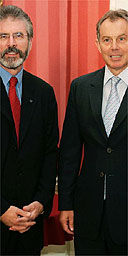
Mr Blair posed for photographs with the Sinn Féin delegation, after meeting the two groups separately. Pointedly, however, he publicly shook hands with Mr Paisley but not with Mr Adams, which would have been a historic first.
Mr Adams made light of the matter. "I have shaken the prime minister's hand on a number of occasions," he said.
