"Put a tiger in a cage and it will be much wilder than one that is free to roam," says Frank Schäfer, the most sought-after stylist in communist East Germany. Schäfer, who nowadays runs a popular hair salon in the boho Berlin district of Prenzlauer Berg where his speciality is styling pubic hair, is one of the protagonists in the newly released documentary Ein Traum in Erdbeerfolie (Strawberry Foil Dreams), out in Germany this week. Directed by the former state-certified model Marco Wilms, Strawberry Foil Dreams takes us on a touching journey back to the wild and wonderful underground world of fashion design in the German Democratic Republic (GDR), which demonstrates how wild and creative people can be in a cage when they have nowhere else to go.
Twenty years after the fall of the wall, Wilms gathered together some of the so-called überlebenskünstler or "survival artists" of the time who made up the scene and defied the authorities to hold their own fashion shows in everything from living rooms to churches and defunct bathing houses.
The state secret police, or Stasi, ensured that life in the GDR was restrictive by keeping a close eye on its subversive youth. "We were something like the decadent fools of the workers' state - a wonderful status to have," Wilms says. "The Stasi observed us with fascination like they were looking through the window in a padded cell, and we were trapped inside a steam boiler, ready to burst out."
The repression might have led to a complete stifling of creative impulses. Instead, in its way, it helped to nurture the bohemians' improvisation and innovation skills. Schäfer recalls: "The young people wanted to dye their hair, but there was no dye available. We discovered that if you applied a cream normally used for treating fungal infections, it would turn it pink or light green."
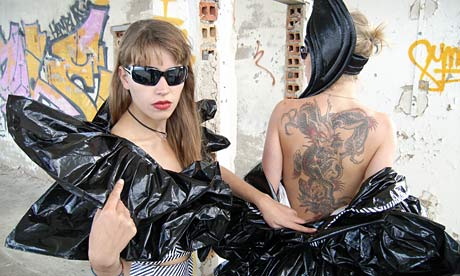
Sabine von Oettingen, the Vivienne Westwood of east Berlin, and the brains behind the underground fashion movements Chic, Charming and Durable, and All Kinds of Fur, made it her mission to incorporate as many everyday GDR objects as possible into her fashion garments. "We used so-called strawberry foil (a durable black plastic that East German farmers used to protect their plants), shower curtains, postal sacks, car tires, sanitary towels, brooms, hospital body bags - everything that felt good and that expressed what we wanted to express," she explains. The results, both as seen in the film, and as displayed on a catwalk at its premiere, are quite spectacular.
"We made a specific point of only using objects from the GDR," she says. When West Germans took pity on her and offered to bring materials from the west, she says she politely declined, "because it had to be stuff that I could find in large quantities in the East."
In 1988, she married a gay American in order to flee to the west. "I wanted to travel," she says. "I cried at the sheer variety of fabric I found when I first went to Paris." Nowadays, she creates new designs in a room in her house and sells them on art markets. She drools over expensive wax cotton and artificial modern fibres used for sportswear "that feel like a second skin".
Wilms fled the GDR in the months before the wall fell. But his is far from being a film about the problems of living in a repressive state - rather it is a celebration of what the east Berlin bohemians achieved, creatively adapting western influences like punk and new wave for themselves. "We didn't have to worry about existential things. Rent cost just 20 ostmarks a month, which compared to the strenuous dictatorship of the industrialised economy we live in today, was immensely liberating."
Wilms also tracked down his old friends and recreated an Ost Bloc party in his spacious Berlin flat, which was formerly a squat. "If we wanted to take a trip to the beach to put on a nude fashion show, have an orgy or a barbecue, we were able to spontaneously do it.
"There's a deep sadness for the lost parallel world we inhabited. The film is a tribute to my generation."
