
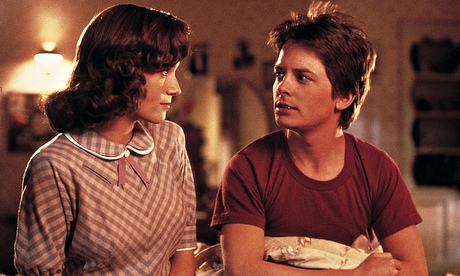
In Back to the Future, it is emphasised from the beginning how mortified Marty is by his weak father and drunken mother, and how disappointing they are as parents. It is only when he goes back to 1955 that he is able to teach his parents how to be the people they always wanted to be and, by extension, the parents he wants them to be. The ultimate message of all these movies is, your parents are idiots and you are right.
“It’s in the 80s that you really start to see what I call the Tyranny of the Teen, with that repeated message: your family is mixed up, and you know everything,” says Steven Gaydos, editor of Variety. “Also, a lot of people from the world of TV commercials and family TV were starting to make movies in Hollywood; people like Jeffrey Katzenberg and Michael Eisner, who knew how to sell things to young people. They realised that people over 40 weren’t seeing movies, so they created films that valourised young people’s experience. There was less finger-wagging and more, ‘Why are adults so weird?’”
But because these movies were asking “Why are adults so weird?”, adults were made more of a central feature of teen films than ever before.
Teenagers are supposed to be rebellious: that’s what movies had been saying ever since the 50s. Teenagers in 80s films, however, had a very different kind of rebellion. Not for them did biking across the country high on cocaine appeal. Ferris Bueller skives off school to go to a fancy restaurant, the stock exchange, a museum and a parade. Ren (Kevin Bacon) in Footloose wants to have a prom. Daniel (Ralph Macchio) in The Karate Kid wants his mother to have a nice house. Sam in Sixteen Candles wants to have a birthday cake. As rebellion goes, these kids make Milhouse from The Simpsons look like Johnny Rotten. In Back to the Future, Marty’s meddling in the past results in his parents living in a nicer house with choicer furnishings, posher breakfast dishes and even domestic help in the form of Biff Tannen in 1985. Marty’s triumph is to lift his family up to middle-class status.
As much as teen films railed against the importance of social class in America, the teen protagonists themselves all aimed very much to be part of the mainstream middle-class world. This is part of the reason why 80s teen films still hold so much appeal to middle-class kids today: the forms of rebellion depicted in them feel eminently accessible and familiar. Back to the Future would definitely be made now – plenty of spectacle, guaranteed franchise material – and it’s not too hard to imagine a studio remaking it, maybe starring Channing Tatum or some such. But it would be a completely different film because Lorraine and George would not be at the heart of it. As much as movie marketers want to reach as many quadrants of an audience as possible, teen movies today are about teenagers and not adults, so as to keep the focus on the most important audience members: teenagers. A teen movie in which the love story is the one between the parents would be unthinkable. More obviously, the idea of a mom trying to seduce her son in a mainstream teen movie would just never fly today because that would be too risky, too ick, too dependent on subtle acting and storytelling. Stiffler’s mom seducing her son’s friends in American Pie? Raunchy good fun. Stiffler’s mom unwittingly seducing her son? No.
Hollywood is far too risk-averse for such things now. Teen films in the 1980s taught kids three things about their parents: if they are divorced, they’ll get back together for you; they will never notice when you’ve had a party; and they are deeply, deeply square. But George McFly and Lorraine Baines taught them something else as well: parents are weird, but they’re weird just like you’re weird, and no matter what the kids in The Breakfast Club say, some day you will be them, too, and that’s why parents in smart teen films are so fun. Because while you might be able to change destiny and become a sci-fi writer instead of a bullied wimp, George McFly-style, you can’t ever change that.
• This is an edited extract from Life Moves Pretty Fast by Hadley Freeman, published by 4th Estate. To order a copy for £9.99 (RRP £12.99) go to bookshop.theguardian.com or call 0330 333 6846. Free UK p&p over £10, online orders only. Phone orders min p&p of £1.99.
