
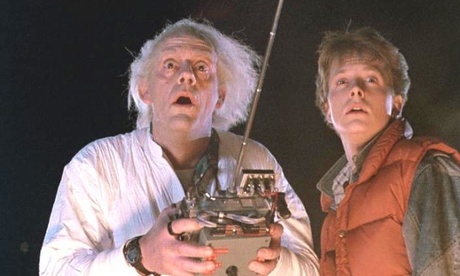
Back to the Future day, 21 October 2015, is the day on which time travellers Marty McFly and Doc Brown arrived in the sequel to Robert Zemeckis’s 1985 classic. Zemeckis envisaged a world dominated by technology, but which of the film’s predictions came true, and which might happen soon? And how did it miss the mobile phone – a massive gamechanger that was already in use in 1989?
The day also marks the eve of the Manchester Science Festival which celebrates #futureday with a special screening followed by a discussion led by Professor Andy Miah, chair in science communication & future media at the University of Salford.
“A meta-layer of hyper-reality”
Back to the Future II was full of product placement, which has given rise to what Miah describes as “a meta-layer of hyper-reality” whereby brands are capitalising on the cultural references in the film. On 21 October, Pepsi are launching limited edition bottles of “Pepsi Perfect.” Nike has announced a version of Marty’s self-tying shoes and Toyota, also featured in the film, has announced a variation of the hydrogen fuel cell technology that powered Doc Brown’s DeLorean. Although Hendo has recreated the famous hoverboard, the similar-looking self-balancing scooters have caught on, although it is illegal to ride them on public streets in the UK.
“Ultimately, certain technologies become part of our landscape, whether or not they are legal,” observes Miah, adding that the same regulations apply to skateboarding, but people do it anyway. Similar considerations apply to drones. The film has a drone news camera and a drone walking a dog. “Often one of the challenges for regulating technology is that the culture of use runs ahead of regulation. Public uptake of technology combined with innovative product developers make it hard to curtail the use of certain devices once they achieve critical mass.”
A parallel highway in the sky
Flying cars are everywhere in Back to the Future II, and according to Miah, although we are not quite there yet, we have the technology. “This and other science fiction films envisage a parallel highway system in the sky, very much like the one we have on the roads, just higher up,” he says. Amazon’s campaign for commercial drone flights includes proposals for a designated airspace for drones between 200ft and 400ft above ground.
This might be the first step towards flying cars, says Miah, as conceivably that airspace could be populated by all kinds of flying vehicles, not just drones. ”It’s possible that within 30 or 40 years we’ll see the aerial highway that science fiction writers imagine.”
The main limitation is safety. This could be addressed by a combination of current technology – the driverless car and anti-collision sensors. “The convergence between drones and driverless cars is inevitable,” says Miah. “Once you designate drone airspace you have the platform for a passenger vehicle system.”
Personalisation and the mobile gamechanger
Back to the Future II got a lot right – voice activation, video calls, a multi-screen environment (although the screens were on a single device rather than multiple devices), robot waiters, biometric identification and payment (using fingerprint verification) and more. But although it features devices similar to the Apple Watch and Google Glass, it missed the biggest gamechanger – mobility. This is because it did not foresee technology consumerisation reaching critical mass and people becoming personally invested in technology. The phones in the film belonged to the household, not the individuals.
As Miah explains, technology develops within social systems: “It isn’t about whether technology is possible; rather, it’s about our trajectory towards using it everywhere and putting everything into it. It wasn’t imagined that the mobile device would become the place where everything would be located – until it happened.”
We have also become preoccupied with data forecasting – this is only touched on in the film, when data from a 2015 sports almanac brought back to 1985 wins Biff the money to shape the future. Ironically, there is a possibility that the Chicago Cubs may win their first World Series triumph since 1908, a prophecy that was written into the film as a joke.
Fantasy into reality
The correlation/causality between science fiction and reality is not a one-way street. Miah flags up the significant extent to which science fiction feeds technology. Dr Nicola Millard of BT’s global innovation team agrees, adding that if science fiction is grounded in good science, it leads to better predictions. Until a genuine disruptor – the smartphone – changes everything. Millard adds that in order to hit the mainstream, technology needs to be useful, useable and used – it needs to achieve a critical mass before it becomes part of the social and business landscape.
Events and discussions around Back to the Future day prompt us to think about our future. An important question is how far ahead should we be looking? Miah believes that a 30-year window is about right – it’s far enough ahead to expect significant developments, but enables us to envisage a world we’re likely to inhabit. Recent sci-fi films have focused on artificial intelligence and distant space travel as well as the consequences of climate change. In 30 years’ time will we be considering how closely Ex Machina, Her, Interstellar or The Martian came to predicting our future?
Joanna Goodman is a writer and editor. Follow her on Twitter @JoannaMG22
To get weekly news analysis, job alerts and event notifications direct to your inbox, sign up free for Media and Tech Network membership.
All Guardian Media and Tech Network content is editorially independent except for pieces labelled “Brought to you by” – find out more here.
