It is Friday lunchtime, and we are driving along the M4, loaded with camping equipment, my wife at the wheel. Although the scene is terribly familiar, it also feels like something we’ve grown out of. It’s been ages since we camped, or were stupid enough to risk the M4 on a Friday in summer. The two children in the back are now silent, hulking teens. The satnav that got stolen from the car a year ago has been replaced by a phone app that knows everything.
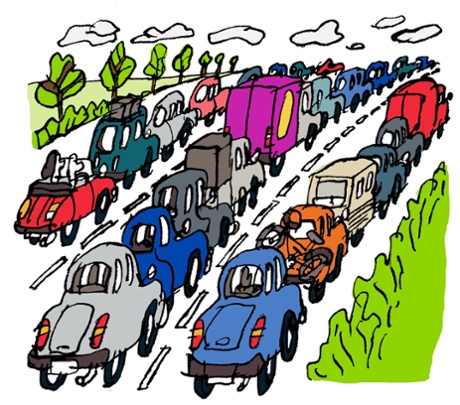
And then, suddenly, we’re not driving on the M4: three lines of stationary traffic stretch ahead of us to the horizon.
“We knew this would happen,” my wife says.
“We probably should have got off back there,” I say, consulting my phone.
“To go where, exactly?” my wife says.
“Sort of down,” I say, scrolling across open countryside with my thumb. “And then around to… hmmm.”
Two hours later we reach a point that was once the horizon. Traffic stretches to the new horizon.
“How long now?” says the youngest.
“No one knows,” I say.
“Stay on M4,” says my phone.
After five hours we’re still the wrong side of Bristol. A creepy calm has descended over the car’s interior, as if we’d always planned to spend the weekend in it. Without warning, some space opens up ahead of us. Scenery begins to wind by slowly, and the jam by degrees unlocks itself.
Eventually we leave the M4 and head south. For the first time in many hours we find ourselves approaching the speed limit. The sun hangs heavy in the western sky. We’re on our second episode of the Archers.
“Incident on the M5,” says the middle one, leaning forward with his phone.
“Where?” I say.
“Dunno,” he says. I scroll down south of Bridgwater, until I spy an exclamation mark superimposed on the carriageway.
“It’s ahead of us,” I say, pressing Resume.
“In one and a half miles,” says the phone, “exit left.”
“We need to get off up here,” I say.
“But it’s all finally moving,” my wife says.
“I know,” I say, “but the phone is now saying we should take the A38.”
“I’m not doing that,” says my wife.
“You don’t understand,” I say. “The phone has changed its mind.”
“I don’t want to,” my wife says.
“This one just up here,” I say, pointing. The exit sails past. We round a bend and take our place at the back of a line of unmoving brake lights. I look down at my phone and see that it’s added 45 minutes to our estimated arrival time.
“Why didn’t you get off back there?” I shout. “When I told you to?”
“How dare you,” says my wife. “I’ve been driving for six hours!”
“What’s that got to do with it?” I say. “You didn’t listen to me, and now we’re fucked. We…”
My wife unleashes a stream of invective that leaves me in no doubt I have misspoken. The windows buzz and rattle; the children push their earphones in deeper. As I lean my forehead against the window, I am consoled by the sight of the same scene repeated in cars all around me: drivers shrieking, passengers gesturing with glowing phones.
We treat ourselves to 30 minutes of total silence, followed by a long and halting rapprochement – plenty of time, it turns out, before the next exit. We take it, along with a hundred other cars, all of us against the advice of our phones. As we inch up the choked exit ramp, talking in low voices, there is a sense of collective resignation that one might, in the gathering gloom, mistake for tenderness.
