
So it begins... the formal general election campaign is under way and most national newspapers, still the foremost political agenda-setters in the land*, know where they will place their bets.
No surprises, of course, about the mountain of blue chips: Daily Telegraph, Daily Mail, Daily Express, Daily Star, the Sun, the Times. The small stack of red chips will be played by the Daily Mirror.
It’s hard to imagine any paper daring to bother with yellow chips. So, for the moment, we must imagine the Guardian, the Independent and i sitting at the press election table with a modest pile of white chips. The Financial Times? Pink, of course.
An Express editorial, urging readers to beware of “lies, damned lies and Labour economics” wasn’t satisfied with just one cliché. Instead it harked back to its insistent message of the 1950s by referring to the Labour party as - wait for it - “socialists”. How quaint!
The Sun’s leader writer asked its readers one of those laughably loaded questions:
“There are two choices, the PM claims. Stick with his Tories, with the economic recovery, job figures on the up and a sense of optimism for the future.
Or go with Ed Miliband and economic chaos; where hard-working Brits will be clobbered with a massive tax bill leap of more than £3,000 over the next five years; where jobs and the recovery will be plunged into crisis”.
It praised the the Tories for playing it straight and concluded: “On May 7 there is really only one choice”.
The Times, though unimpressed with David Cameron’s strategy to stick solely to economic arguments that stress the benefits of his government’s fiscal conservatism, was even more critical of “Labour’s pitch”.
It pointed to Andrew Neil’s interview with Labour’s campaign coordinator, Lucy Powell, on his Sunday Politics programme in which she struggled, said the Times, “to defend a fiscal position which rests entirely on the restoration of a 50p rate of income tax”.
Neil’s “forensic questioning” of Powell, said the Mail’s leading article, Labour’s black hole, was something of a “car crash”. (My memo to all parties: Neil is now TV’s most dangerous political interviewer, so don’t send him lightweights because he’ll eat them alive).
The Telegraph indicated its concern about Cameron’s ability “to win back disgruntled Conservatives” in the face of an “inbuilt bias towards Labour in the electoral system”.
It therefore concentrated its fire on Nick Clegg’s Lib Dems for ratting on the deal to institute boundary changes that would have helped the Tories. The Telegraph, in Torygraph form, said:
“The boundary review was torpedoed by Nick Clegg because the Tories opposed House of Lords reform. It was, in other words, done in a fit of pique that shattered the Lib Dems’ self-righteous espousal of high principle, and partly accounts for their precipitous decline in the polls.
The country may be about to rue the day that the electoral unfairness Mr Clegg once declared to be ‘unacceptable’ was left intact”.
So the blue chippers acted in predictable fashion, as did the red chip red-top, the Mirror.
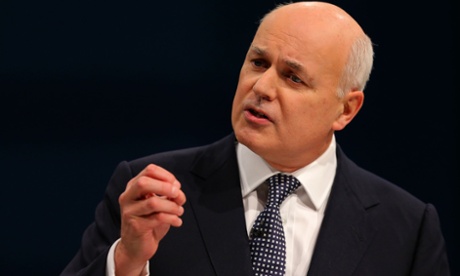
It poured scorn on Iain Duncan Smith, work and pensions secretary, for his refusal, when being interviewed on Andrew Marr’s show, to detail how he plans to cut £12bn more from the welfare budget should the Tories win.
He “personifies the out of touch arrogance of Tories who think they’re above accountability”, said the Mirror. His “refusal to explain where his axe would fall was utterly disgraceful, suggesting the Conservative coward is frightened of the backlash”.
The Indy also thought Duncan Smith was guilty of “squirming” over his “secret” plans, which emerged through a leaked document. It backed the call by Labour’s Rachel Reeves that the Conservatives “need to come clean about their plans for welfare before 7 May”.
Whichever party wins, said the paper, welfare will take a hit. It concluded:
“Beyond the arguments over cash, we should also not forget that the disabled are some of the most vulnerable people in society. It would seem grotesque if they were made to suffer simply because many of them are in no position physically to kick up much of a fuss.
A decent level of provision for their needs is something that we should be proud of. If civil servants are seriously advising Mr Duncan Smith to slash disability payments, he should send them back to the drawing board”.
That Independent white chip definitely has a pink tinge. As for the Guardian, its leading article was devoted to extolling the virtues of coalition government:
“As the five years of the Tory/Lib Dem government draw to an end, it is right to recognise one striking achievement... it has not only survived, but also functioned...
Five years ago, many doubted that this kind of government was possible. The unsustainability of a Tory/Lib Dem deal was confidently forecast even before the 2010 election and frequently predicted after it was formed.
‘When will the coalition break up?’ became a political parlour game. Yet the much-touted Lib Dem revolt against coalition refused to happen. In the end, those who argued that the coalition would survive to the end have been vindicated”.
It wasn’t weak government. Few bills were lost. A fixed-term parliament “proved a safeguard against opportunist splits”.
The Financial Times also noted that the coalition “endured and even thrived, despite the apprehension of the larger partner and the political near-immolation of the smaller”.
It carried out “a full programme of government”, as time passed, “each party has at times thwarted the other, notably in the arena of political reform”.
But “the worst parliamentary ruptures brewed up within the Conservatives as they waged their interminable civil war overEurope”. The FT praised the Lib Dems for their conduct and concluded:
“Scaremongering about indecisive election results will never again possess the same force. Voters will have become more accustomed to their politicians arguing, bickering and horse-trading; a coalition is merely an arrangement for this to happen more in the open”.
*But is there another platform setting a different agenda?
I do believe the national press sets the overall agenda but television has a big part to play too. It was noticeable that BBC TV interviews by Andrews Neil and Marr provided newspaper headlines.
Then, of course, there is the computer screen and its mobile equivalents, which are the preferred reading and viewing platforms for first-time voters.
Vice UK, the innovative news outlet, is gearing up to make films that “will examine issues such as the housing crisis, poverty and young people’s disillusionment with the political system”, reports Adam Sherwin in the Independent.
And, note also, these videos will not be bound by Ofcom’s requirements for political balance.
Don’t forget BuzzFeed, which might try to show it is more than an entertyianment medium.
And the social media platforms, Twitter and Facebook, will play a part too. Sherwin quotes Facebook’s Elizabeth Linder as saying: “Politics was the most discussed topic on Facebook in the UK in 2014”.
Really? Can that be true? The figures suggest it has been so. Could this therefore be the last election in which the printed press hold sway?
