The story of Robert Durst, currently in custody in New Orleans and charged with murder after apparently incriminating himself in the television documentary series The Jinx, has all the elements of a Hollywood thriller. In fact, one element appears to have been lifted wholesale from the master of suspense, Alfred Hitchcock.
In The Jinx, Durst’s apparently unguarded confession – “What the hell did I do? Killed them all, of course” – occurs after the film-makers present him with a letter he wrote to his friend Susan Berman which bore a close resemblance to an anonymous note sent by Berman’s killer to the Beverly Hills police on the day of her murder. Both were written in similar block letters, and the word “Beverly” was misspelled as “Beverley” in both cases.
In the series it is a moment of high drama. Film buffs, however, may feel they have seen it all before.
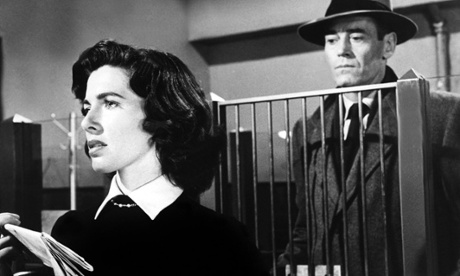
In Hitchcock’s 1956 film The Wrong Man, Henry Fonda plays Manny Balestrero, a musician who is arrested after staff at an insurance company identify him as the man who held up their office twice a few months earlier.
The police ask him for a handwriting sample, getting him to write the words from the stick-up note at the insurance company. The block-letter handwriting bears some similarities and crucially Balestrero misspells the word “drawer” as “draw” – the same mistake as the robber made.
For the rest of the film Balestrero struggles with increasing desperation to prove his innocence. He is eventually exonerated when the true robber is arrested holding up a grocery store, although at the end of the movie his wife is in hospital suffering from depression.
In the movie’s prologue, Hitchcock, in his only speaking role on the big screen, assures viewers that “every word is true”, and indeed the movie is based on the “The True Story of Christopher Emmanuel Balestrero”, a 1953 Life magazine story. Balestrero worked as a musician at the Stork Club in New York and died decades after his ordeal in North Carolina in 1998. British-born Hitchcock, whose earlier work included Suspicion and Dial M For Murder, went on to make the classic Psycho in 1960.
Of course, the movies are the movies and real life is real life. But don’t be surprised, if this case ever comes to trial in California, to find lawyers calling Alfred Hitchcock and Henry Fonda in Durst’s defence.
