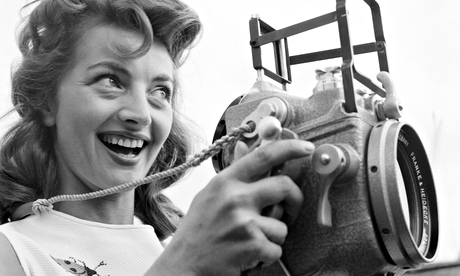
In an era heralded by some as the golden age of television, Lotte Hass, who has died aged 86, was known as the first lady of diving. She and her husband, Hans, filmed their undersea adventures and brought into viewers’ living rooms for the first time the mysteries of the deep, as they faced devil fish, sharks, stingrays, octopuses and other creatures.
In 1954, before shooting their first television series, the Hasses appeared on the BBC radio Light Programme series Danger Is Our Business and recalled an adventure in the Caribbean. They described how a sealion attacked Hans and a giant clam seized Lotte by the foot, holding her below the water. Hans saved her life by using a spear to kill the clam. They first came to television in the six-part BBC series Diving to Adventure (1956), in which they roamed the Red Sea, the Caribbean and the Aegean in their three-masted schooner, Xarifa.
The couple not only opened a window on the undersea world, but also demonstrated the new lightweight diving equipment and photographic technology that allowed them to do so. Hans made television programmes of his expeditions – forerunners to Jacques Cousteau’s many series – to finance his pioneering scientific research, and recorded both English and German commentaries, but the documentaries were most popular in Britain.
The Hasses returned in The Undersea World of Adventure (1958), filmed in the Indian Ocean and screened in the BBC’s Travellers’ Tales strand. They were also in the Indian Ocean for two series of Adventure (1959-60). The first episode, with hundreds of fish meeting, mating, laying their eggs and protecting themselves against their enemies in a coral forest below a rock, contained all the elements that kept viewers glued to their screens.
Lotte gave up diving and film-making when Hans switched to studying human behaviour in the 1960s, but her contribution to those pioneering days was celebrated in the 2011 film drama Das Mädchen auf dem Meeresgrund (The Girl on the Ocean Floor), based on her 1970 book.
She was born in Vienna, the daughter of Stefanie (nee Kitzmantel) and Karl Baierl. On leaving Wenzgasse school in 1947, Lotte abandoned plans to go to university on hearing that Hass – whose work, including his newly released first feature-length film, Menschen Unter Haien (Men Among Sharks), she had admired – was looking for a secretary. He hired her.
Eager to join a 1950 Red Sea expedition as his assistant, she trained in swimming pools and took photographs under the waters around Vienna. Hass said the work was too hard and dangerous for a woman, but the producers of the planned documentary saw the commercial potential and persuaded him to agree. They also wanted it to be presented as a story, with Lotte joining the team of underwater explorers.
The result was Abenteuer im Roten Meer (titled Under the Red Sea for English-language versions, 1951), filmed and narrated by both Hans and Lotte, and featuring the first underwater footage of whale sharks. Whether contrived or not, one sequence shows the rescue of Lotte – the first woman to explore the Red Sea’s coral reef – after she is apparently knocked out during an encounter with a giant manta ray. A colour illustration of her wearing a tight-fitting swimsuit and holding a spear up to an approaching shark adorned the film’s publicity posters and she featured on the cover of magazines worldwide. The 1951 Venice film festival named Under the Red Sea best feature-length documentary.
In 1950, on finishing the expedition, and following Hans’s divorce from the actor Hannelore Schroth, Hans and Lotte had married in a civil ceremony next to Lake Zurich. In 1963, they had a church wedding in Vienna.
Money made from Under the Red Sea enabled Hans to buy his new marine research vessel, Xarifa. In 1953, it set sail from Hamburg for the couple’s next expedition, recorded in Unternehmen Xarifa (Under the Caribbean, 1954), the first German film to be shot in Technicolor. This journey through the Galápagos archipelago, Cocos Islands and the Caribbean included the first underwater pictures of sperm whales.
In 2000, Lotte was inducted into the Women Divers Hall of Fame and, with Hans, into the International Scuba Diving Hall of Fame. Hans died in 2013. Lotte is survived by their daughter, Meta.
• Lotte Hass (Charlotte Hildegard Baierl), diver and film-maker, born 6 November 1928; died 14 January 2015
