
What are we going to do about “not-spots”? Have you heard of “not-spots”? Do they ring a bell? Well, no, they absolutely do not ring a bell! A bell will not ring in a not-spot for love nor money. Unless you’ve set an alarm, I suppose. Anyway, even if you haven’t heard of not-spots, you’ll certainly have experienced them. They’re places where you can’t get any mobile phone reception and, according to culture secretary Sajid Javid, they’re “unacceptable”.
I find them pretty unacceptable too. As an expression, I mean. It’s clearly a humouresque take on “hot spots”. You must have heard of hot spots. They’re where cats like to sit – usually caused by a warm pipe under the floorboards. And to bring things bang up to date, a hot spot is also what my phone will rather heroically create to allow my laptop haltingly to get online in the absence of proper WiFi. The phone uses whatever 3 or 4G it’s enjoying to create some proper non-phone internet access, albeit at extortionate cost in terms of my monthly data allowance. I love doing it though – it makes me feel like I’ve reversed the polarity of the neutron flow. Then, if I can just reroute the data inversity-spectrum using the copper in that nearby telegraph pole, I should be able to turn my iPad into a rudimentary hoverboard.
So hot spots are where there’s some sort of signal, so someone obviously thought it would be neat to call an area that lacks this invisible infrastructure a “not-spot”. And it’s annoying because its feeble comic force is left there in common usage, getting worn down over time, like an old poster for a Jimmy Cricket gig that has been marched over by a retreating army.
Sajid Javid hates not-spots even more than I do, and wants phone companies to eradicate them. He’s even suggested some ways it might be done: sharing masts, letting brands such as Tesco or Virgin sell contracts that can access all four networks, or allowing “national roaming” where your phone can use all the suppliers’ signals like it does when you’re abroad (and like abroadsters’ phones do here – grr!). “I would prefer a voluntary solution from the mobile network operators…” he told the Today programme; failing that, the government “won’t hesitate to take mandated action”. So it’s the same kind of voluntary action as when the Nazis offered Rommel a pill.
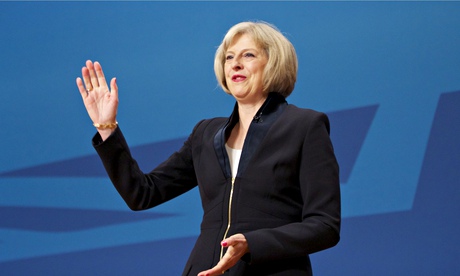
It’s not just mobile operators for whom Javid’s proposals rankle. Theresa May also considers not-spots to be a necessary evil – a concept to warm the cockles of any Tory home secretary’s heart. In a letter leaked to the Times, she complained that national roaming “could have a detrimental impact on law enforcement, security and intelligence agency access to communications data”. She wants the police to be unhampered in their access to “information that is crucial to keeping us safe”. By “us”, I assume she means the public, not just the government.
Couched though it is in sober, responsible language, this is a truly shameful thing for her to say. The extent to which the security services should be allowed to listen to, record and analyse everyone’s private communications is a fraught issue. Many would contend that our loss of privacy in the face of an organisation as powerful as the government is, in effect, an enormous and unacceptable curtailment of freedom. They look to Benjamin Franklin’s warning that, by sacrificing liberty for safety, we forfeit our right to be either safe or free. Others say that, in a functioning democracy and these violent times, it’s prudent to grant the security services more investigative licence. Reasonable points can be made on both sides.
But Theresa May is the first person, as far as I know, to suggest that people’s activities should be restricted in order actually to facilitate the security services’ surveillance – to claim not only that it’s permissible for the police to snoop on everything we do and say, but also that we should be discouraged or prevented from doing things the police might have trouble keeping track of.
“Come off it!” some of you may be thinking. “She can’t be the first!” And of course you’re right – I’m exaggerating. She’s certainly not the first person ever – throughout history her point has frequently been made. In fact, the states of the former communist bloc were entirely predicated on this principle, as were most fascist regimes. It’s one of the issues over which Lenin and Tsar Nicholas II would probably find common ground if they got stuck with each other at an awkward drinks party in hell.
Like Theresa May, many totalitarian governments have noticed how tricky it is to monitor millions. It’s even harder than keeping count of a flock of sheep, because not only do humans move around even more than livestock, some of them actively don’t want to be counted. Only terrorists and criminals, of course – Ms May is clearly convinced of that. So much so that she believes the undoubted convenience to customers of being able to use more than one phone network – this clear and beneficial correction to the market – should be sacrificed because it would play havoc with spies’ admin. It would make it harder to snoop on everyone.
But there are so many other things people do that make surveillance harder. We move house whenever we want, we travel wherever we like – at the drop of a hat, without telling anyone. What honest person needs to do that? Why not register our movements – submit them to a brief and streamlined vetting process – just to help the security services keep us safe? What’s the harm? Why the need for secrecy? Other than the security services’ secrecy of course – which is vital to national security and in all of our best interests. Why would anyone want to whisper unless they’d got something to hide? So let’s speak up loud and clear into our trustworthy guardians’ microphones.
Politicians are always having to resign – for shagging the wrong person, for lying about their expenses, for texting a photo of their cock (there’s never a not-spot when you need one). Fair enough. But it is a worrying indication of the national mood that Theresa May’s position remains completely secure in the aftermath of her frightening remarks. The priorities she reveals in her letter are truly shocking and, much more than the worst excesses of dishonesty, infidelity and ineptitude that we’ve seen from our leaders in recent years, make her utterly unfit for government.
David Mitchell’s new book, Thinking About It Only Makes It Worse, is published by Guardian/Faber (£18.99). Click here to order it for £13.49. Join David Mitchell in conversation with Observer editor John Mulholland at the Royal Geographical Society on Wednesday 12 November. Tickets cost £20
