
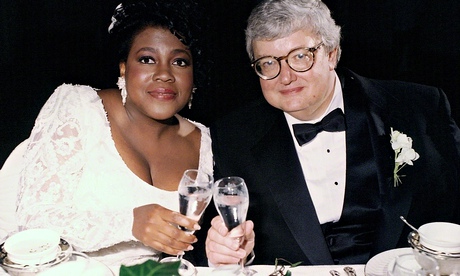
Roger Ebert loved to share a good story. Life Itself, a documentary on the late Chicago Sun-Times film critic, shows Ebert telling one of his own. There he was, in hospital, recovering from surgery for cancer of the jawbone. His wife, Chaz, was ready for them to go home, but Roger – stubborn as well as romantic – wanted to hear one of their favourite songs before they left. They listened to Leonard Cohen’s I’m Your Man. Before the song ended Roger suffered a haemorrhage and was rushed back into theatre. “If the song had been shorter and I had left – I’d be dead,” he says. Same thing if he’d been less insistent, too.
Ebert died of cancer on 4 April 2013 at the age of 70. Hoop Dreams director Steve James filmed him in his final five months – Ebert was terribly sick, but still taking joy from watching and writing about movies. He follows Ebert into hospital, films as nurses use suction to clear his throat, watches Roger and Chaz cry and argue and laugh together. Throughout, it’s obvious that Ebert, with some 6,000 reviews under his belt, knows the power of the camera. At one point he tells James to film himself in the mirror – the critic telling the film-maker how to make his movie better.
Life Itself, based on Ebert’s memoir of the same name, is a celebration of the life of a Pulitzer-winning critic who became one of the first to combine cultural theory with unabashed populism. Ebert arrived on the scene in the late 1960s, when the New Yorker’s Pauline Kael and the Village Voice’s Andrew Sarris were revolutionising the form. Before them, newspapers tended to offer their film columns to any old staff journalist. The Sun-Times’s rival, the Chicago Tribune, would publish its reviews under the pseudonym “Mae Tinee” (matinee). Ebert, picture-bylined and always in full ownership of his opinion, became one of the first personality critics.
“Roger’s life was a microcosm of the changing film industry,” says James. “He encouraged this idea that you don’t just come out of a film and say: ‘Yeah, I liked it.’ Or: ‘Ahhh, I didn’t like it.’ You explain why you liked it and you didn’t like it. And you argue about it over dinner. He made that something that people did. He was a big part of the democratisation of film criticism.”
Television played a huge part in bringing Ebert to the people. His long-running review show with Tribune writer Gene Siskel, At the Movies, was syndicated in the US and Canada, making the pair recognisable in a way that film critics had rarely been before. They championed a “thumbs up, thumbs down” rating system, but their relationship was much more ambiguous. James shows archive footage of them bitching at each other in outtakes. It was the antagonism that raised the temperature of the show. The viewers loved their fights. Ebert liked being loved.
“He loved being famous,” says James. “But he loved it in a way that didn’t prevent him from still being this everyman. I would see him at festivals taking pictures of people. He was a fan. He was standing in line to go to screenings, he wasn’t being ushered in at the last minute with the seat set aside for Roger Ebert. He could have had the entourage, he could have revelled in all of that.”
James didn’t know Ebert that well before he made Life Itself. Ebert had raved about Hoop Dreams (“more dramatic, more moving and more surprising than fiction”) and interviewed the film-maker a couple of times, but James says the distance helped. It allowed him to show Ebert warts and all. His early alcoholism is discussed. His ego and occasional mercilessness get an airing. How does James think Ebert would have reviewed Life Itself?
“With the level of humility he came to in his later life, he might not [have],” James says. “He might just say, ‘It’s out there, let people go to it.’ I do fantasise about him reviewing it. But I thought about him throughout the entire process. I felt like, when I was editing, Roger was right here: ‘Make it rich, make it good, don’t give short shrift to my faults. Please don’t give me tribute’.”
In his later years, Ebert embraced the internet. He blogged about films, about his relationship with Chaz, about his memories of a life in the industry and about his cancer. When surgery left him unable to talk, his blog became his voice. Ebert, in his last days, was still replying to the comments on his reviews. It was another new medium, but it required the same skills: know a good story, always remember who you’re writing for. Ebert never forgot the audience. He wrote to them on his blog the day before he died.
“Thank you for being the best readers any film critic could ask for,” he wrote. “I’ll see you at the movies.”
• Life Itself is released in the UK on 14 November
