
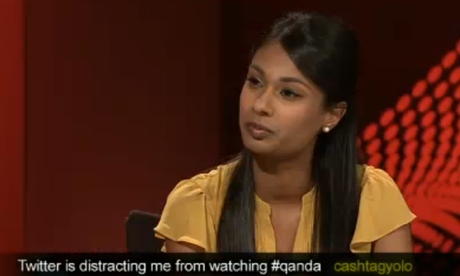
Imagine if every live concert featured a madman on the side of the stage who insisted on sporadically stepping up to a microphone to read out, over the music, what people were tweeting about the gig. “@RiffBalls says ‘Ooh, think the lead guitarist just hit a bum note #WholeGigRuined’.”
That would be ridiculous, right? On television, however, it’s deemed perfectly acceptable to visually interrupt my viewing with the poorly thought-out finger droppings of people I’ve never expressed any desire to hear from.
By inviting people to “join the conversation” with tweets along the bottom of the screen, most TV shows now look like they’ve been invaded by subtitles from another, worse show I’ve cleverly avoided (some god-awful program where people are actively encouraged to express the first thought that enters their heads rather than waiting for it to evolve into a better one).
With the power of digital, isn’t it possible now to offer me a magic button that removes the internet hive mind from the bottom of my screen? I don’t want it there. I want to watch the TV without a series of mentally derelict monologues being superimposed over it. Hey, while we’re at it, why not get the Louvre to project what @gr01nFac3 thinks, directly onto the Mona Lisa? I’m sure paying guests would love that.
On Q&A, for example, I either get enraged by tweets that I agree with (“Hey everyone, global warming can’t be ignored” – yes, I know, I bloody well know) or, even worse, for the sake of balance they then have to put something up that’s objectively false, otherwise the ABC will be accused of left-wing bias (read as “scientifically robust”). It means that for 50% of the show I feel like there’s a line of idiots queuing up, taking turns to sit next to me on the sofa and shout one pointless thing at the television. When did we all sign up for this? Can I apply to be part of the show’s studio audience just so I can watch it blissfully unaware of what @TurdKnuckle thinks?
I won’t go into the actual content of SBS’s First Contact, Guardian Australia’s Paul Daley did a great job of covering it here. It was an excellent program; probably one of the few things worth watching on Australian television all year. It’s such a shame then that tweeting along made people forget how to watch television.
Minutes into the episode, people online were pouring vitriol on Bo-dene, completely forgetting the premise of the show: that by spending time with Indigenous Australians, one’s ignorance might gradually be chipped away.
Can’t anyone just watch a whole show and then comment on it once its aim has been achieved? Of course not. If you waited until the end, there would be nothing to tweet your three-followers-gaining outrage about. But that’s the gift Twitter has left us: a misplaced sense of entitlement to express one’s opinion as soon as it forms.
Such impatience led to the bizarre scenario where, thanks to difference in time zone, in Western Australia Bo-dene was a vile, ignorant racist, while simultaneously being a redeemed, intelligent young woman on the east coast. If only everyone had bothered to wait for the Earth to rotate a little bit, there now wouldn’t be a long, digital canon of prematurely judgmental guff. It’s like watching X-Men and then seeing people in the first three minutes tweeting “Ah, this Logan’s a rude arsehole. Get him off.” No. You. Wait.
With awards shows or political events, I can understand live-tweeting: it’s a useful method of keeping up-to-date. For a show such as First Contact, a show that was always – obviously – going to to have an arc, it just encourages comments that are made devoid of an appreciation of what the show is trying to achieve.
Don’t encourage people to join the conversation. Encourage people to watch and learn. Conversationally, hoping for measured comments from the internet is a futile exercise. You might as well sift through someone’s colonic irrigation in the hope of finding an intact club sandwich.
