
The nature of perfection is one of those abstracts that, though forever undefinable, we’ll still spend hours bickering over it. At certain times anything can be perfect – a cold drink on a hot day, a first kiss, a red shell in second place on the last lap. We may not be able to say what perfection is, but we know it when we feel it.
Which doesn’t mean there are no rules. When thinking of perfection in games a useful guideline is the word’s etymological root – the Latin perficio, meaning to finish something. That is, a perfect game is such a complete realisation of its concept that you can’t imagine it ever being surpassed; it’s “perfect” in the sense that the idea has nowhere left to go.
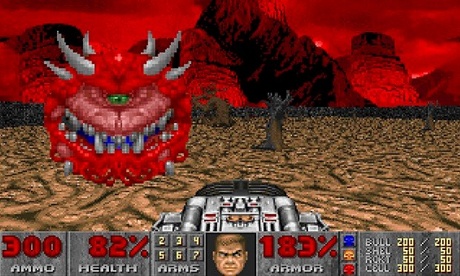
This is important because a perfect game need not necessarily be a timeless one – though they often are. I ran a quick Twitter poll about perfect games and an immediate, overwhelming favourite was id software’s 1993 first-person shooter Doom.
Rise of the space marine
Doom is certainly brilliant, and unlike almost any other early 3D title, remains a pleasure to play. But what makes it perfect is that, even though other games have improved on elements of it, the overall design has not been surpassed within its type. Doom popularised the FPS genre, establishing a “pure shooter” template and weapon-set that has often been imitated but never bettered or even much diverged-from in the years since. Subsequent FPS titles have added not-inconsiderable aspects like the ability to look up and down, or more fullyfeatured multiplayer modes, but the core of Doom remains a kind of urtext for the hyper-accelerated aggressive style of shooter.
The other side to Doom is its simplicity. Compared to the kind of FPS game we play in 2014, it’s stripped-back and laser-focused, and this seems to be a key principle of what people think of as a perfect game.
Consequently, there’s a kind of sweet spot for early 1990s 2D titles – frequent candidates for “perfection” include the likes of Sensible World of Soccer, Super Mario World, Super Metroid and The Legend of Zelda. These games focused on getting simple mechanics spot-on, and then crafting a game around them. Many contemporary titles now considered modern classics are similarly based around nailing a core mechanic.
Super Meat Boy, for example, is a twitch platformer built around an intuitive but very deep control system. Spelunky is a procedurally generated platform adventure, or “roguelike”, that combines countless simple elements into very different and complex playthroughs (all underpinned by exceptional mechanics). Fez is a little more out-there, but again is constructed around a single perfect core mechanic.
Perfect polygons
But what about complex 3D games? The likes of Metal Gear Solid 3, Prince of Persia: The Sands of Time, Super Monkey Ball, Resident Evil 4, God Hand, Vanquish, Portal and Dark Soul are all considered perfect by some.
Let’s look at characteristics they share. Some have exquisite control systems based around navigating a complex 3D space in a new kind of way – Super Monkey Ball and Vanquish, for example. Some are built around a range of character abilities and “intelligent” enemies, and the game’s meat is in combining the two over a series of paced encounters – that’s MGS3, Resi 4 and probably God Hand. Dark Souls set a new standard for 3D world-building by constructing an interconnected single space in which the whole game took place, a tightly-packed open-world that made architectural sense. Portal did kind of the opposite, building discrete spaces for crazy spatial experimentation, while the Sands of Time simply had one amazing idea – rewinding time to reverse your mistakes – and executed it perfectly throughout a very good 3D platformer.
In each case, aspects of these games could be fairly criticised. MGS3 has unbearably long cutscenes, God Hand’s environment textures are poor, Dark Souls’s later areas are clearly rushed. But perfection doesn’t mean flawless. These games are perfect because the one characteristic they all share is exploring a gameplay concept to the uttermost. Super Monkey Ball is an unimprovable simulation of what it would be like to be a monkey encased in a pyrex ball navigating suspended 3D environments. Resident Evil 4 is designed to be gaming’s Die Hard, a pure action set-piece thrillride from start-to-finish, and it maintains this momentum throughout. God Hand ekes out every idea possible within the confines of kicking thugs in the nuts.
The point is that no other game has managed to follow-up these ideas and make something better. God Hand remains singular. Resi 4’s sequels diluted and diminished the formula. Dark Souls II had little to add, and abandoned the overworld structure. Super Monkey Ball’s follow-ons are a sad story of decline.
Singular treats
These games may exist in popular genres, but certain other games achieve perfection by virtue of being unique. Gitaroo Man, a bizarre rhythm game with a super-sweet and surreal setting, is impossible to imitate. So too Katamari Damacy (though Namco has tried), Rhythm Tengoku (though Nintendo has tried), and even it could be argued something The Beatles: Rock Band. The latter may have mechanics entirely based on a pre-existing game, but there’s simply nowhere else to go with the idea of a Fab Four music game.
But let’s focus on two games that proved the most popular crowd-sourced candidates for video game perfection. Tetris, probably the greatest puzzle game ever made, and Super Hexagon, which kind of balances between being a puzzler and a rhythm-twitch game.
Both are simple – but, more than that, they are also minimalist. Tetris’s creator Alexey Pajitnov initially considered building the game around pentonimoes – shapes formed from five blocks. But there are twelve variations of pentonimoes, which he considered too many, and so he settled for tetronimoes (seven variations).
Tetris works in layers. It is easy to play: the shapes and fixed playing field are visually clear, and the controls are comprehensible. The only random element is what shape will come next. As Tetris gets faster and faster, it is almost as if instinct takes over but the end is always the same: a flat parp as you hit the top of the screen, the playing field fills up, and your score’s displayed.
Even though the games are quite dissimilar, Super Hexagon is also built around a very simple interaction – spinning an arrow to guide it through gaps in layers of hexagons – which gets faster. Both games have exactly the same principles underlying them: simple objective followed by an increase in pace that leads to mistakes. Super Hexagon’s rhythm is much more obvious because the exceptional backing track is a key part of the experience, but the principle is identical.
Perfection, subtraction and addition
I described Tetris and Super Hexagon as minimalist, and what’s important is that you could not remove or add a single mechanic to either and improve it. This is a good guide for perfect games – you could say, for example, that the PlayStation 2 adventure Ico is the ultimate example of 3D minimalism. But then who would exclude games like Bayonetta, Journey, Planescape: Torment, or Street Fighter II?
The more you think of it the more there are. Super Mario Kart on the SNES has to be in there. Does Team Fortress 2 or Counter-Strike get left on the sidelines? Not on my watch. I think of perfect as an expansive term rather than a closed shop, something that describes a flawed-but-complete achievement rather than an unattainable ideal.
When I asked Twitter for perfect games, one of the more surprising candidates proffered was the PlayStation 2-era bling-’em-up Def Jam: Fight for NY. That was alongside votes for The Bard’s Tale, Mother 3, and Sin & Punishment 2.
So what’s your choice?
