
It was a family Christmas, almost 10 years ago, and my sister was angry that I'd forgotten to buy a smoke alarm for her house. She died in a fire. Just my luck. And I ended up moving in with her husband and children. I didn't mean for that to happen. Love strikes when you're not paying attention. She didn't believe that, of course. We didn't speak much on Christmas day.
That was actually because I spent a lot of the holiday designing an exact replica of my family in the world of Sims 2 and ignoring my real one. Occasionally one of them would look over my shoulder and ask how their life was going. That's how my sister discovered her death and my subsequent betrayal. But Sims isn't often that exciting. Like life, it's mostly a continuous cycle of eating, washing, working, maintaining relationships and going to the loo. Yet it's the bestselling franchise in PC history. So how mundane can a game be and still be enjoyable? In fact, are these even opposing ideas?
"Mundane" is from the French, meaning, "of this world". And certainly there are games whose aim is to stay planted in reality. At playspent.org you can explore for free what it's like to live on the poverty line by facing a series of choices about how to spend earnings of $1,000 a month. When given options such as asking a friend for money, the game cleverly takes you directly to your Facebook account to experience the actual ignominy of that choice, rather than divorcing it from reality.
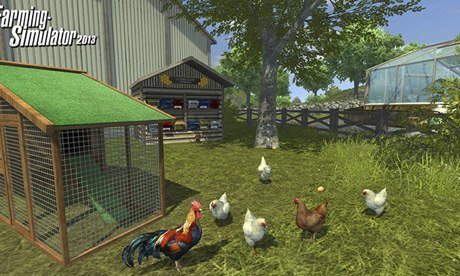
Farming Simulator is a charmingly awful game in which you plough up and down a field, apparently simulating an agricultural lifestyle, in a sort of hypnotic acceptance of your life being slowly scythed away. It's truly mundane but Ed Byrne admitted to being addicted to it on Mock the Week recently, and many others must feel the same as it's topped global sales charts in the past.
More complicated is the eerie, old-school Papers, Please by Lucas Pope. In this, you play a border control officer, deciding who can enter the country by examining their passports, papers and comparing them to a rulebook you've been issued. It's essentially a 70s Eastern bloc desk job. The sound and graphics of the game are excellent at conjuring up the tense, Stasi atmosphere, and the stakes are high when your failures see innocents killed, your pay docked and your family punished. But as I cross-referenced yet another seal to see if it matched its issuing city, I did wonder whether I was a villain for becoming the callous immigration guard the game encouraged, or an idiot for doing all this admin work for no real pay. Especially since I have piles of filing to do in my actual office.
But games like this, which embrace a certain truth, do tend to be the most emotionally involving. For the first third of The Last of Us, I was frustrated by its weapons system insisting on taking an inordinately long time to change guns. We've become used to accessing immediately a range of brilliantly designed arms from some time-pausing wheeland any challenge to that can initially feel like a step backwards. But play on and this seems like a deliberate choice to make more realistic one's responses to enemy encounters.
When faced with two assailants, my reaction in real life would be to panic and hide and The Last of Us encourages that sort of response, drawing the player deeper into an imagining of the actual situation. This meant that by the time I was ending the game I was properly embroiled rather than just impressively tooled up.
So what about the other end of the spectrum? Well, Saints Row IV seems to have decided to make mundanity its enemy. A whirling, sugary pastiche of a game, you play the president trapped inside a simulation, killing and jumping with fictitious abandon and a dubstep rifle. The effect of this is boundless fun but little engagement of the heart. At its core though is a rather clever premise, because just as I began to wonder why I should care about mowing down innocent pedestrians, since they are only deleted avatars, I realised that of course that is all you're ever doing anyway, and the creators of Saints Row were making that point deliberately by playing up the game within a game.
Of the open worlds out there, Saints Row IV seems like the Scrappy-Doo to its gluttonous uncle, Grand Theft Auto V. The crime in Grand Theft Auto V isn't just theft, or even casual sexism (though it's full of both), it's also how dull it can be. It's a sumptuous, technical marvel, lit like a Rembrandt. But there's only so long you can gaze at the perfectly rendered fairground games before you realise you can't actually play them. For all the furious machismo around the release, a lot of GTA is driving back and forth like the tired parent of school-age children, running empty errands and giving lifts, wondering what happened to your own ambitions.
But what's attractive is spending time in that beautifully realised landscape. And that's where mundanity ceases to matter and can even be a reassuring salve. I like games that keep one foot in this world; it reminds me to do that myself. And now I'm off to ring my sister and get her to check the batteries in her smoke alarm.
