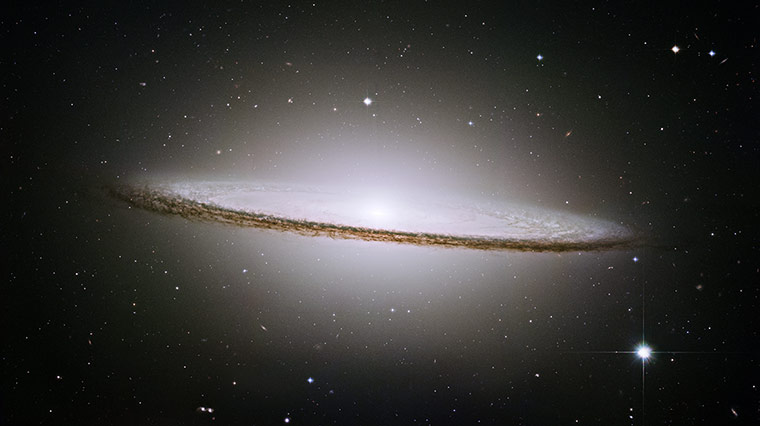
Like other spiral galaxies, the Sombrero consists of a flat disc of stars surrounding a fatter central 'bulge'. However, here this central core of stars extends out to encompass the whole of the disc in a halo of stars. Like most galaxies, the heart of the Sombrero conceals a dark secret: a supermassive black hole containing as much matter as a billion Suns Photograph: NASA and the Hubble Heritage Team (STScI/AURA)
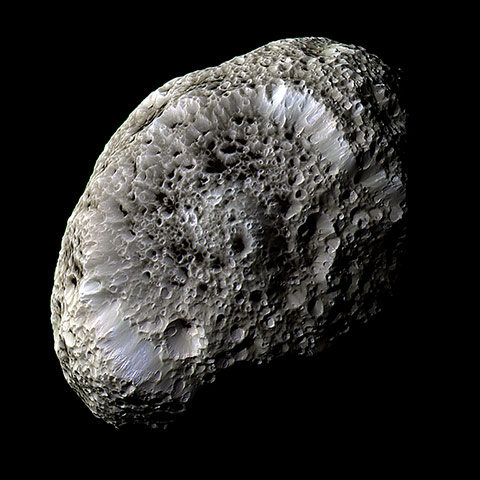
This sponge-like object is one of the most bizarre of Saturn's family of more than 60 moons. Longer than 360km from end to end, Hyperion is made largely of ice and has the consistency of a loose pile of rubble. Its surface is covered with irregular sharp-edged craters dusted with a mysterious dark material that may have originated on Phoebe, another of Saturn's moons Photograph: NASA/JPL/Space Science Institute

Here, two lost hikers stand in a bubble of torchlight in Yosemite national park, California. The picture captures the last remnants of daylight and the bright dust clouds of the Milky Way. The image strongly conveys the wonder, beauty and awe of astronomy Photograph: Steven Christenson, 2011

The three bright stars on the left in this image are those of Orion’s Belt. Although part of a familiar constellation, a view such as this can never be seen with the naked eye. Only with long exposure time and a sensitive camera can we see the dramatic landscape of glowing gas and dust clouds that lie between the visible stars Photograph: Rogelio Bernal Andreo, 2009

This startling view of Saturn's ring system shows how image-processing techniques can be used to convey scientific information. Saturn's clouds are shown in their natural colours, but false-colour enhancement has been used to show the density of the icy particles making up the rings Photograph: NASA/JPL
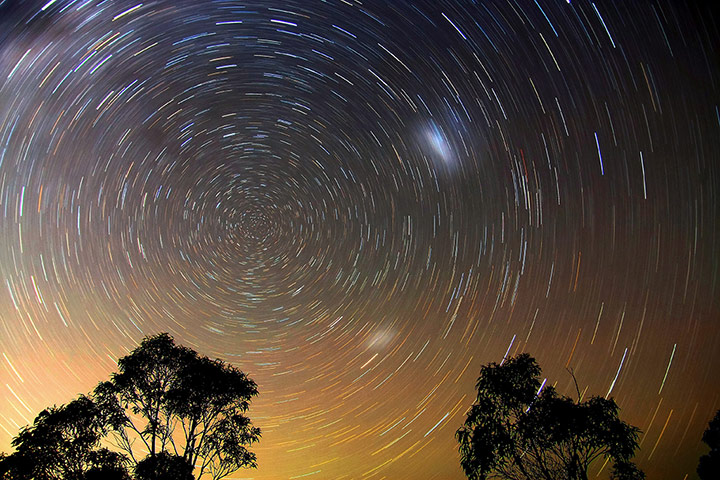
As Earth rotates during the 30-minute exposure of this photograph the stars make trails around the sky's south pole. Taken in Australia, the Large and Small Magellanic Clouds, two neighbouring galaxies, appear as faint blurs in the sky. An equivalent photograph taken from Britain would show Polaris (the Pole Star) at the centre of the star trails. Photographer Ted Dobosz won the 'Earth and Space' category, Astronomy photographer of the year, 2009 Photograph: Ted Dobosz, 2009

Stripping away the clouds, the surface of Venus is revealed to be a tortured volcanic landscape scarred by vast forces from the planet's interior. This false-colour image of Venus was created by bouncing radio signals off the planet's surface. Unlike visible light, radio waves can penetrate the thick layers of cloud, allowing us to map the planet in detail Photograph: NASA

Stars such as our Sun die slowly, gently expelling their outer layers over millions of years. But for stars more than 10 times as massive as the Sun, the end is extremely violent. When its nuclear fuel runs out, the core of the star collapses, triggering a huge explosion that rips the outer layers of the star apart, blasting them outwards. The Crab Nebula is the debris from one of these 'supernova' explosions
Photograph: Nasa/ESA/J Hester and A Loll (Arizona State University) Photograph: NASA/ESA/J. Hester and A. Loll (Arizona State University)
