
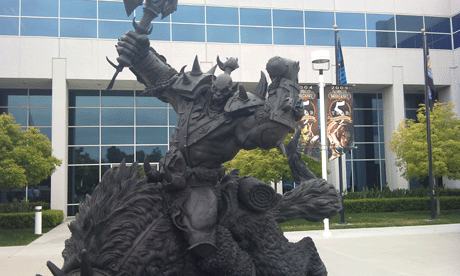
Outside Blizzard's offices in Irvine, California, in a large square surrounded by picnic tables and well-maintained lawns, there is a 15ft high statue of an orc riding a wolf. Designed in conjunction with Oscar-winning special effects company Weta Workshop, it was forged in China then shipped to the US in two enormous pieces. Many developers just don't bother to erect statues outside their offices, but Blizzard is different – it has, after all, constructed its own extraordinarily elaborate fantasy realm with 11 million subscribers. And if you think you take World of Warcraft seriously, you have absolutely nothing on the people who make it. They love this game, and they have a gigantic statue to prove it.
Now in its sixth year of business, World of Warcraft has outlived most of its contemporaries in the notoriously tough 'MMORPG' genre. With its third expansion pack on the way, an add-on that's somehow designed to indulge complete newcomers as well as long-term fanatics, it looks set to hang around for several more years – even if Blizzard is already working on a 'next-gen' successor.
The question these days is, what more can be done to energise a game that's now seen six years of patches, expansion packs and endless raiding, questing and dungeon hacking? Where is this world heading? And how do the staff stay motivated? I mean, they have the statue, but is that enough?
One thing is immediately clear: as the title suggests, the story behind the forthcoming Catalcylsm expansion pack is not one of just maintaining the narrative status quo. No, it is the story of a giant dragon named Deathwing, exiled beneath the surface of Azeroth since his defeat in Warcraft II, who has now erupted back into the world to seek vengeance on – well, pretty much everybody. This apocalyptic re-birth has caused some massive changes to areas of the familiar WoW map; in our demo, for example, Blizzard show us the vast Stormwind City, which now has a deep, devastating fissure running through it, splitting the urban centre in two. Over in Thousand Needles canyon a gigantic dyke has been destroyed, flooding a huge expanse of desert. And in the background, with the death of the Lich King, there is massive political upheaval. All the factions are wrestling for control of the blighted kingdom. A war of biblical proportions is all but inevitable.
But it's not all been about creating a giant apocalyptic mess. Now that the WoW emphasis has retuned to the original areas of the map, the lands present before the Burning Crusade and Wrath of the Lich King expansions, the design team have taken the opportunity to re-energise things a little. So apart from the destruction caused by Deathwing, Stormwind City also has a new keep, a sprawling building which will house its own story elements complimenting the Cataclysm plot line. "It's the way we always envisioned it" says lead content designer Cory Stockton, "A proper landmark". Furthermore, a second trading area has been built so the Dwarven quarter now has its own bank, auction house and inn. These seem like small elements, but to experienced players, for whom the geography of Stromwind is intimately familiar, it's like tearing down a whole section of their hometown and erecting some eye-catching Norman Foster skyscraper.
But most dramatically, the fact that players can now hop on to flying 'mounts' (an array of obedient dragon-like creatures) and explore the classic areas by air has meant that whole regions have had to be rethought. As lead game designer Tom Chilton explains, "we never designed the original world to support flying, there were tons of things [to prevent it]: there were flat scenic facades, there were large parts of the world that had never been finished… At the time we thought, 'ah, that's just an area for a some future expansion, we don't need to worry about it now', so we'd just have a giant field of grass or an ocean, or we'd block it off with mountains.
"But when we introduced flying in Burning Crusade, players were saying, 'this is awesome, but when can we fly in the old world too?' And we thought, 'yeah, we sort of expected that'. But it was no trivial thing for us to go back and rebuild the world to support flying. It's something we've only had the chance to do with Cataclysm." To illustrate the changes forced by the inclusion of flight, Blizzard shows off a huge expanse of ground behind Stormwind City – once unreachable, it has been re-landscaped with lakes, a graveyard and its own range of NPCs and quests.
Meanwhile, in the Orc stronghold of Orgrimmar, the new Horde leader, Garrosh, has been carrying out some design changes of his own. Decking out every building in masses of jutting black steel, he's created an imposing fortified metropolis, complete with new flight paths and landing pads for the Horde's steam punk-style zeppelin craft. New areas of Orgrimmar have also been constructed for the monstrous Tauren and for the goblins and trolls, who find themselves ghettoised on the outer reaches of the city, in messy shanty areas.
Interestingly, Cataclysm does seem to have this underlying theme of displacement – of unfavoured peoples clinging to the lower echelons of the power structure. The undead race known as The Forsaken are effectively refugees, lacking a homeland and engaged in combat with more settled and powerful foes – as with the modern Battlestar Galactica series, there's more going on under the surface of this fantasy fiction than mere genre plotting. Indeed, Stockton asserts that the Blizzard designers are keen to explore wider ideas and implications. "There are huge underlying themes to all of our big stories, and lots of those have come from the Warcraft series as a whole," he explains. "When you see the idea of betrayal, that's something that's happened throughout. And there's the idea of how war can split people apart, and how that allows bad thing to happen."
He also points to the political tensions between WoW's tribal chiefs, and how the actions of these characters are often as closely scrutinised as genuine world leaders. "Sylvanas, as a leader, is so powerful, what we have her say and do in the game has a big impact – players will take one line of dialogue and if it doesn't match what we're trying to do [with the story] it gets taken out of context. It's the same with Obama, if he says one thing that doesn't match up, people take it in a different way…" This is crucial stuff, really, in understanding the lasting pull of WoW. It's a world fraught with recognisable tensions, a world that explores themes of race, identity and homeland. It's not just a string of epic battles fudged together with some Tolkienesque imagery.
Cataclysm also offers plenty of new areas to discover, exhibiting fresh architectural and geographical influences. Uldum, for example, is a level 83/84 zone with an overt Ancient Egyptian theme. Statues of animalistic gods line the streets, beside hieroglyph covered towers and sandstone buildings. Stockton explains that this whole area was once cloaked by the Titans, a powerful race of demi-gods, but when the cataclysm hit, the gigantic shield generators failed, and the city was revealed, attracting hordes of plunders and tomb raiders.
This subplot reflects another intriguing new addition to the WoW experience: archaeology. Characters with the requisite skill will be able to search specific areas for buried fragments left by long dead civilisations, which can then be assembled into items. These will mostly be collectibles such as vanity pets, toys, mounts and rare weapons. However, Archaeologists will also be able to decipher runes that provide unique buffs for themselves and their party.
The Blizzard team also shows us Deepholm, a hellish spherical cavern from which Deepwing bursts at the opening of Catacylsm, tearing asunder the surface of the planet and unearthing the Elemental Plane, a sort of subterranean prison dimension, constructed to contain the ancient elemental spirits. It's all shadowy crevices and spooky blue green lighting, with stone troggs lumbering about in the semi-darkness. At the bottom of the pit lies the ruined Horde gunship, Orgrim's hammer, which lead world designer, Alex Afrasiabi, says points to, "some interesting lore shake-ups".
And then there's Skywall, the elemental plane of air, which provides a dramatic new dungeon area. It's a collection of marble palaces atop cloudy mountain peaks, linked by intricate arched walkways. Players will be able to fly there on mounts, then take on a range of dragons and elemental warlords. "You've never seen anything like this in Wow before," enthuses, Afrasiabi "I mean, it looks like a painting – but these are all places you can go to..."
Part two tomorrow.
