
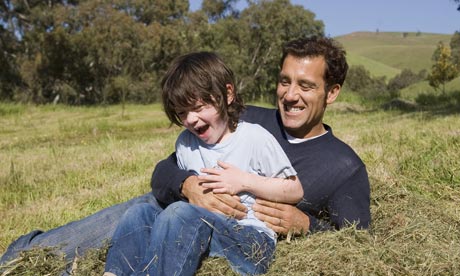
If you could order a heart-tugging movie about a widower single dad from the Boden catalogue, accessorised with emotional moments purchased online at johnlewis.com, it might look like this excruciatingly artificial and prettified film, on which lies a 98-tog duvet of middlebrow good taste. Directed by Scott Hicks, who made Shine, it is adapted from the bestselling 2001 memoir by British author and journalist Simon Carr about bringing up two boys alone when his wife died. It is, however, adapted freely enough to count as a soft-focus work of romantic fiction. Not one single thing, for one single moment, looks real or sincere – not the elaborately designed "mess" in the widower dad's neglected kitchen, not the golden sunlit exterior of his picturesque, rambling Australian house, not the hassled-yet-gorgeous blonde single mum in the long-sleeved woollen cardy that the widower dad later meets, and certainly not his alpha-male job as top sportswriter. (In real life, Carr is the Independent's admired parliamentary correspondent.)
Clive Owen plays Joe Warr, a Brit journalist who has evidently risen briskly to the very top at the sports section of an Australian national paper. His beautiful wife Katy, played by Laura Fraser, is the mother of an adored little boy. But things are complicated. Warr is divorced, and has left his first wife and son by that marriage back home in England, where unspoken resentments still fester. Catastrophe strikes when Katy dies of cancer, and Joe must be a single dad – initially with just his younger son, taking him on a contrived and directionless "road trip" to nowhere, and then with both boys in a house which descends into poignant male chaos.
Without a woman's love, Joe regresses into a damaged Peter Pan, larking around with his boys with a defiant insistence on taking risks, embracing life, but also through a need to avoid confronting his emotional pain.
It should be a touching story, but everything is so over-controlled, over-designed. Joe will keep on having posthumous visions of his wife, in which she truly, madly, deeply tells him to get over himself and just talk honestly to his grieving boy. She is of course down-to-earth and matter-of-fact in the accepted style, but also cloyingly and exasperatingly perfect.
As for Clive Owen, he is a stylish performer in the right role, who could have made a great 007 – and may in fact yet do so. But frankly, his facial expression is here jammed on "hunky-sensitive", switching occasionally to "vulnerable", and there is something unvarying and even slightly baffling about his performance. A phoney, sugary tale without substance.
