
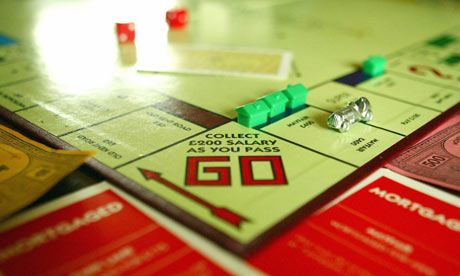
Monopoly – the game – has had a long and complicated pedigree. It first gained traction in the 1930s, partially stimulated by a need to escape from the economic woes of the depression.
If it has an equivalent today it is Farmville, available on the social website Facebook, which claims an astonishing 74 million regular users. It is the most successful of a number of similar games on Facebook which are themselves part of a wider boom in gaming during the recession.
Farmville is like a real farm. If you don't crop your harvest in time or feed your cartoony animals regularly then you face disaster. Like Monopoly it is power-driven to the extent that everyone wants to beat competitors and have the biggest farm. Like Monopoly its success has been generated by its users.
Parker Brothers, who later acquired the rights, famously turned Monopoly down in 1934 as "too complicated, too technical … took too long to play". They listed "52 fundamental playing errors", and it was only later when they became of aware of huge demand spontaneously generated by the public – which the small company which then marketed it couldn't cope with – that they changed their minds and bought the company and earlier patents.
Gaming would probably be on a roll anyway but during a recession there is an added impetus to play video games you already own more intensively rather than spend money on entertainment or to savour some of the burgeoning free games on offer. The boom is difficult to quantify partly because aggregated statistics for all forms of gaming are difficult to find but also because so much of it is free.
We are experiencing an explosion of games based on the "freemium" model whereby publishers give it away in the hope that at least 5% of players will trade up to a paid model or else trigger advertising revenue.
The boom is being experienced everywhere except on the bottom line. Widespread redundancies among traditional publishers and developers are coinciding with a surge in demand in other sectors.
The casual gaming site miniclip.com of Hatton Garden, London, was at one stage claiming 50 million unique users a month, while Getjar.com, another UK-based indie company, claims to be the biggest app downloader after Apple. Playfish.com, another big casual gaming site, was bought for $275m in November by the games giant Electronic Arts, which has experienced a sharp drop in profits. And Activision's Call of Duty: Modern Warfare 2 made $1bn in its first couple of months, which is a result comparable to the unprecedented success of the 3D blockbuster film Avatar.
What seems to be happening, despite the huge success of some titles, is a switch from expensive video-based games to cheaper-to-produce ones residing on mobile phones, online, or on social networks – which is where all the eyeballs are anyway. It is reckoned that more than half of iPhone users are playing games. Morgan Securities says demand for online gaming will double annually for a few years, to $800m this year and $1.6bn next.
It has been presumed that the centre of gravity for gaming will switch to Apple's app store (which this month added a version of Grand Theft Auto to its growing games portfolio) but now the outlook is not so sure.
The success of Facebook has raised the prospect that social networks could be the place people go to for games. The iPhone, for all its undoubted success is still a minority sport. The mobile guru Tomi Ahonen reminds us that "only 0.7% – yes less than 1% – of all who have a mobile phone on the planet, have an iPhone", and in any case apps only work on smartphones which so far only account for about 14% of the installed base of mobile phones (but, of course, are growing fast).
Developers are finding it increasingly difficult to make any noise among the avalanche of apps in the iPhone store, let alone any money. Apple's disclosure that total downloads have exceeded 3bn is an amazing success story, though not as big as it looks once you have allowed for the fact that most downloads are free and the figures also include downloads of updates.
Games embracing Google's Android operating system – based, unlike iPhone apps, on open source – could offer serious competition to Apple; as could Nokia, which is still the biggest mobile phone manufacturer in the world by a distance.
Companies faced with investing millions in new video games or much smaller sums in the mobile market – towards which everything, including social networks, are migrating – may well take the cheaper option. Either way, a lot of companies are likely to go under before the wheat is separated from the chaff. In this market, the consumer is still king.
