
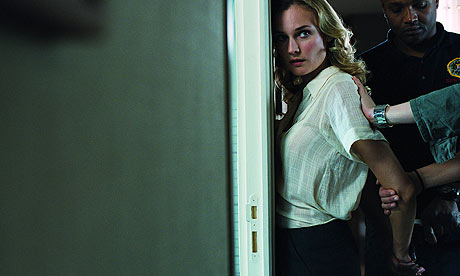
For newcomers to the French thriller genre, Anything for Her (Pour Elle) is not necessarily the most successful example. "The fundamental silliness and improbability of everything [in this film] is an insuperable problem," said one critic. Others were more positive: "The intense action sequences and gritty drama are compelling," said another.
A perhaps unintended, but in my view more useful, consequence of this film is the interest it has awakened in miscarriages of justice, drawing in viewers as the wrong that one family suffers at the hands of the law unfolds.
Julien (Vincent Lindon), a happily married schoolteacher, is shocked when his wife, Lisa (Diane Kruger), is whisked away from their home by a police squad one night. Assuming the police came for him – the film opens with a violent but unseen encounter between Julien and another man – it plays on assumptions that sudden arrests on suspicion of murder are likely to affect men, not women.
The film follows the family as Lisa, who it turns out was an innocent passerby near the scene of her boss's murder, is unable to prove her innocence against apparently strong but, we know, deeply flawed evidence. Lisa deteriorates mentally and physically in jail while her frantic husband sets about a long and, it has to be said, increasingly improbable plot to secure her release.
Complete with photo collages on the wall, textbook-like lessons from an old lag who conveniently specialises in breaking out of jail, clumsy attempts to obtain fake documents and a fairly ridiculous plan for an escape from what is clearly a high-security prison, Julien's attempt to become a sufficiently hardened criminal to free his wife is never completely convincing.
What is indisputably compelling however, is the depiction of an innocent woman severed from her family and incarcerated in a windowless, loveless jail, having exhausted her options to appeal. Although the film spends relatively little time with Lisa, the regular glimpses of her hopeless existence give a haunting insight into the plight of a person who knows they are innocent but has no way of proving it.
Echoing the sentiments of real-life miscarriage of justice victims, who feel entitled to ignore prison rules because their innocence means they have not genuinely met the conditions of incarceration, the film raises questions about the ethics of breaking the law to remedy the wrong. Julien will stop at nothing to rescue his wife – robbery, murder, deceit – and, in what can only be an indictment of how serious is the injustice he is trying to remedy, it may be hard to believe but it is easy to empathise.
