
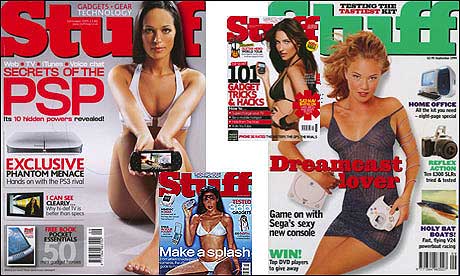
"MiniDisc is dead – exclusive look at the new disc format that will bury it," reads the magazine coverline. Intrigued? You will be when you flick inside. Because the format that will beat the MiniDisc is the … DataPlay.
No, me neither. But it must have made sense in September 2002, when Stuff magazine proudly trumpeted its latest discovery. "DataPlay is a brand new format that crams 500MB of information on to a disc the size of a 50 pence piece," the magazine said.
But who could confidently say that they would always pick the product likely to succeed? Gadget spotting is a tricky thing. "A good gadget either fulfils a need or creates a need," says Jason Bradbury from Channel Five's The Gadget Show. "For instance, once you've tried mobile internet on a device that's really good at it, then you start to need to be connected to the digital ether – whereas before you didn't."
"It's definitely not an exact science," says Tom Dunmore, Stuff's editor-in-chief, who has been with the magazine since 1999 – it is now celebrating a decade of publishing in its current incarnation.
Cutting through the hype, however, can sometimes make those decisions about what's likely to be a hit more difficult. Pre-iPod, a UK Apple launch "would be 20 Mac journalists in a room in the basement of a hotel", Dunmore says. Consider the equivalent hysteria now. So how can journalists resist the lure of excitement and massive buzz when it comes to choosing which gadgets to feature?
Jason Jenkins, editor of the technology review site CNET.co.uk, says quality of reporting is paramount. "Expert knowledge is essential to be able to place the product in its proper context – is an AMOLED screen really a groundbreaking feature on a new phone, for example, or does every other mobile have it already? Come to mention it, what is an AMOLED screen anyway – and why should the reader care?"
Of course, there are some products that will end up on magazine covers – and indeed newspaper pages – regardless. The PS3, for instance, Nintendo DS or Wii were not going to be ignored. But Bradbury says he tries to steer clear of ramping up – or mouthing off about – the latest products, preferring to look at what we might be seeing over the next two to five years . "I don't make predictions," he says. "You do get little gadgets that I can tell you are going to sell out, but it's small fry." A new USB device to convert your 80s mix tape from cassette to a digital form, for instance, he says, is bound to be a success.
Many technology journalists can cite products they were surprised to see fail. Dunmore points to the Gizmondo games console, and the original Nokia N-Gage phone/gaming system, which Stuff awarded five stars, but subsequently failed to find a market. And in retrospect the magazine's huge support for the Sega Dreamcast – "There's nothing to match it – Dreamcast rules" – perhaps only ever looked convincing in September 1999.
For Bradbury, it was the Sinclair C5 (he owns one). "The problem was that they marketed the C5 as a commuter gadget and it's not – it's a go-kart for big boys."
As well as backing the wrong product, of course, there is always the danger of missing a big trend. "I recall reading a release years ago about one of the first companies to sell ringtones in the UK and writing something along the lines of 'what a ridiculous idea'," says Jenkins. "A few years and a multimillion-pound ringtone industry later, I was forced to eat my words."
But what happens when you buy a product on the basis of media recommendations and then find that it just doesn't catch on? "People don't mind too much unless they buy the wrong format," says Dunmore. "That was a big thing round HD-DVD and Blu-ray – when people get burned for serious amounts of money it can annoy them." Jenkins thinks readers are rather less tolerant. "I would put the margin for error our readers give us at 0%," he says.
And in the current economic climate, splurging cash on technology that disappoints is even more unpalatable. In fact, splurging cash on any new technology at all is looking ever less appealing. So what should early adopters be looking for in the coming few years? "Really, really efficient portable power – batteries that provide days and weeks of power for your mobile and also power that you can send, that is transmittable" will be popular, says Bradbury, which should hopefully bring an end to the piles of cables currently cluttering up your television stand.
He also tips mind control devices – gadgets to help your computer translate your thoughts into actions, that is, rather than mini-robot Derren Browns – as becoming potentially big.
And which products are going to be the next Dreamcasts: left discarded and unloved? "3D televisions. If they think for one minute that families are going to sit down and put goggles on to watch EastEnders they're so wrong," Bradley says.
Presumably we'll see you all in 10 years' time to judge that opinion.
• Stuff's 10th anniversary issue is out now. Watch The Gadget Show on Five at 8pm, Mondays.
