
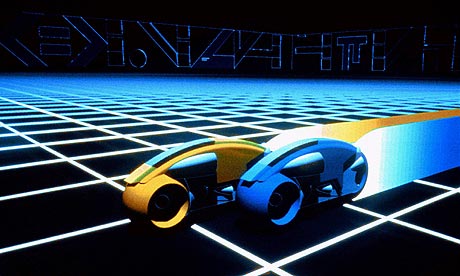
What are virtual worlds for? The idea of being able to use a computer to access an imaginary world has been a staple of science fiction since the film Tron, but it's been less clear what you'd do once you were in a computer-generated world; that is, if you weren't having to battle a devious enemy on a Light Cycle. When the crew of the Enterprise weren't getting trapped in their holodecks due to a totally unexpected weekly malfunction, they used the devices for roleplay. Dave Lister of Red Dwarf used his for sex. But in the absence of total-body immersion, do virtual worlds have a point at all?
Sony came in for a lot of flak when it launched its "Home" central space, open to anyone with a PlayStation 3. The influential blog Penny Arcade commented: "This is what happens when your marketing department tries to make a game," and followed up with an even more damning comic strip. Matthew Ingram of the Toronto Globe and Mail responded with the simple question: "Can Sony get anything right?"
The problem was that Home had the sterility of a corporate-built environment, but without the benefit of lots of corporate-provided entertainment. Users could choose the appearance of their avatars, play some arcade-style games, furnish their houses and wander around the world, but that was about it. Home users in search of entertainment invented Quincying – a practical joke in which an attractive female avatar flirts and dances before suddenly switching appearance to become a male avatar. While I applaud people inventively making their own fun, this is a rather desperate way of finding enjoyment in a theoretically limitless playground.
There's really no point to a virtual world if you can't do things in it that are impossible in the physical world. I cheerfully confess that I'm hopeless at most games that require even mild twitch abilities, but I had a great time messing around in Grand Theft Auto IV just because I could repeatedly crash cars in explosive, exciting ways. World of Warcraft, too, gives players the opportunity to do something that few of us can do in daily life: kill things with giant swords.
What GTA IV and World of Warcraft also have in common, of course, is that they're games. That is, they provide a set of goals, even if they don't insist those goals are fulfilled. And Sony has now understood that this is what was missing from Home. At the end of last month it launched the intriguing Xi – a game within Home's virtual world. Marrying elements of point-and-click adventures with alternate-reality gaming, Xi invites Home users into secret areas of the world. There, they discover that Jess, the designer responsible for a mysterious project codenamed "Xi", has disappeared and they need to find out what's happened to her. The game is just getting started, and players have set up a comprehensive wiki for those who want to pool resources.
And perhaps after all it's the goals that are the most important thing in creating a satisfying virtual world experience. In the real world, we all have many automatic goals, including our physical needs and our natural desire for friendship and love. But what's the point of a world without desires or goals? Even procrastination feels hollow if there's nothing to put off. But once you have a clearly defined set of objectives to ignore, well, that really does feel like relaxation.
