As has been observed, it's hard to be a Jew at Christmas. I grew up an Orthodox Jew and can verify that as a child it's tough to be in a position where your beliefs – or your parents' beliefs – stop you from having the same fun that everyone else around you is having. It gets better as an adult, though; one comes to appreciate that it's good to be able to remove oneself from the commercial madness and be peaceful and reflective at this time of year.
But if Christmas is hard on the observant Jews, I can't help but feel that The Future is going to be a lot harder. And not just because the stringent identity card regulations that seem to be in our future have historically been pretty tricky for the Jews.
Orthodox Jews observe a strict Sabbath from sunset on Friday to sunset on Saturday during which – among other restrictions – they don't use anything electrical, don't travel by motorised transport, don't cook and don't spend money. From personal experience, this can be a very rewarding way to spend 24 hours; a chance to reconnect with the people and things around you rather than using technology to allow your mind to be somewhere separate to your body.
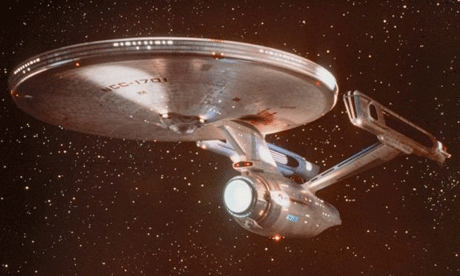
But how will the technological future treat the observant Jews? I used to fret about this a great deal as a child. What would I do if I were travelling on the Starship Enterprise? All the doors are electric! The food is made by replicators and no one seems to own a fridge. Would replicator food be kosher? Moreover, in the wilds of outer space, how would one even know when "sunset on Friday" was, in order to observe the Sabbath?
None of my favourite future-based fiction seemed to offer any answers. If I travelled in the Tardis, presumably I could just avoid the problem by skipping over every Saturday, but I couldn't imagine that a Vogon constructor fleet would be so accommodating.
It's probably obvious that, even as a child, I had a tendency to overthink. But this is likely to become more of a problem for observant Jews as time goes on and it becomes harder to avoid using electronic devices even for one day. Automatic sensor doors, automated lights and swipe-card entry are already commonplace. There are some enterprising solutions to the problems these pose. But if, for example, e-books take over from paper books, I wonder if the Orthodox Jews will be the last people to own libraries of books whose pages can be turned without the use of electricity? Or the last to have doors that lock using metal keys?
Does this really matter? After all, leading an observant Jewish life is a choice. And if a small group of people find that the modern world has become difficult for them to manage and they end up as isolated as the Amish community, is that a problem for the world? Only in this sense, I think: that however wonderful our technology is, it's a good idea to switch it off every once in a while, and a good idea to make sure we're able to.
My friend Adrian Hon and I gave a talk this year at the Geekyoto conference, suggesting a "secular Sabbath" as a way to become more green – it certainly saves energy – but also as a practice that improves quality of life. Just as it can be quite nice to be a Jew at Christmas, a little removed from the tumult of the festivities, it's uplifting to take some time away from the email inbox, phone, computer games and television. And one hopes that, however advanced our technologies become, they always come with an off switch.
